 Ship Modelers Database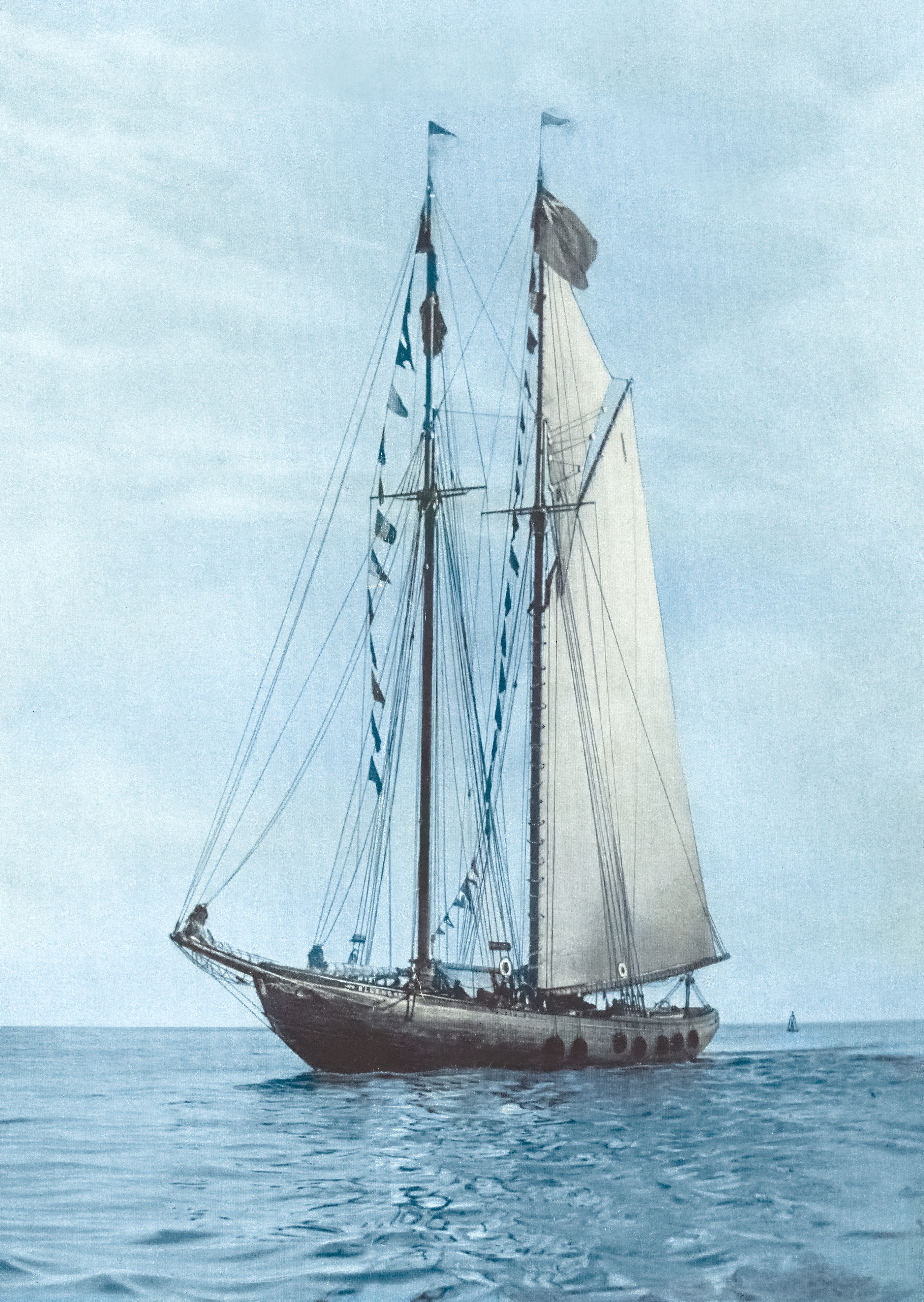
Bluenose
- Type
- Schooner
- Period
- 19th Century
- Nation
- Canada
Overview: Bluenose was a Canadian gaff-rigged fishing and racing schooner built in 1921 at Lunenburg, Nova Scotia, that became one of the most celebrated symbols of Canadian maritime heritage. Designed by William J. Roué and built by Smith and Rhuland, she was created to win back the International Fishermen's Trophy for Nova Scotia and went undefeated in competitive racing for 17 years. Specifications: According to Wikipedia's technical profile, Bluenose had a displacement of 258 t (254 long tons), an overall length of 43.6 m (143 ft 1 in) with a waterline length of 34.1 m (111 ft 11 in), a beam of 8.2 m (26 ft 11 in), and a draught of 4.85 m (15 ft 11 in). Her mainmast stood 38.4 m (126 ft 0 in) and foremast 31.3 m (102 ft 8 in) above deck, carrying a total sail area of 930 m2 (10,000 sq ft) with a crew of 20. Roué's original 1920 design draft had a waterline length that proved too long for the competition rules and was revised, and the bow was raised during construction to give more room in the forecastle. Service History: Bluenose fished the Grand Banks and raced competitively, defeating the Gloucester schooner Elsie to capture the International Fishermen's Trophy and successfully defending it against all American and Canadian challengers for 17 years, including a famous string of races against her rival Gertrude L. Thebaud. As working fishing schooners became obsolete after World War II, Bluenose was sold to haul freight in the West Indies and foundered on a reef off Île-à-Vache, Haiti, on January 28, 1946. Notable Facts: Bluenose and her longtime captain Angus Walters were inducted into the Canadian Sports Hall of Fame in 1955, and her image has appeared on the Canadian dime since 1937, on a postage stamp, and on the Nova Scotia licence plate. A faithful sailing replica, Bluenose II, was built at the same Smith and Rhuland yard and launched in 1963; it survives today as a preserved sailing ambassador vessel based in Lunenburg. Because no complete "as built" plans of the original survive, modelers typically rely on reconstructed drawings (such as those by P.F. Eisnor) compiled from period photographs and records.
Kits of this ship
No image | 1921 Bluenose Fishing Schooner "Old School" (Kit 1003) | BlueJacket Shipcrafters | — | Discontinued |
| Bluenose 1921 Fishing Schooner (AM1447) | Amati Models | 1:100 | Available | |
| Bluenose Canadian Schooner (MS2130) | Model Shipways | 1:64 (3/16 in=1 ft, S) | Available | |
| Bluenose Schooner (Plank-on-Frame) | YuanQing Ship Models | 1:72 | Available | |
| Bluenose (MM11) | Mamoli | 1:160 (N) | Available | |
| Bluenose (BB576) | Billing Boats | 1:65 | Available |
Build Logs
+ Link a build log- Bluenose Model Shipways 1:64 Beautiful shipRob (username per thread) · Ships of Scale(Bluenose Canadian Schooner (MS2130))
Build log documenting the start of a Model Shipways Bluenose kit build with references to other build resources.
- Bluenose - Model Shipways MS2130 - 1/64 - By JeffT [COMPLETED BUILD]JeffT · Ships of Scale(Bluenose Canadian Schooner (MS2130))
Detailed, completed multi-page build log explicitly stating the builder is constructing the Model Shipways Bluenose (MS2130) at 1/64 scale.
- YQ Full Rib Bluenose by Bob WaltersBob Walters · Ships of Scale(Bluenose Schooner (Plank-on-Frame))
Newly started (Nov 2025) in-progress build log of the YuanQing full-rib Bluenose kit, with early posts on keel fitting and frame notch adjustments, later renamed/moved to the dedicated build-log section.
- Bluenose Schooner 1921 - Model Shipways 1:64 by TexBillyTexBilly · Ships of Scale(Bluenose Canadian Schooner (MS2130))
Build log with progress photos referencing the Model Shipways MS2130 kit as the basis of the build, started as the poster's second major project.
- Bluenose 1/64 MS2130 by TechTrek (Chris) [COMPLETED BUILD]TechTrek (Chris) · Ships of Scale(Bluenose Canadian Schooner (MS2130))
Completed first-build log explicitly for the Model Shipways MS2130 Bluenose kit, with detailed progress including rigging, LED lighting, and dories.
- Bluenose Model Shipways build log - MallacootaMallacoota · Ships of Scale(Bluenose Canadian Schooner (MS2130))
Build log referencing the MS2130 plan directly for hull/deck planking details, showing ongoing construction progress with photos.
- YUANQING BLUENOSE - Peter Voogt [COMPLETED BUILD]Peter Voogt · Ships of Scale(Bluenose Schooner (Plank-on-Frame))
Extensive, fully completed build log (161+ pages, ~1180 photos) explicitly documenting construction of the YuanQing Bluenose POF kit from start to finished model.
- YUANQING BLUENOSE _ E J - Eugene SchmidtEugene Schmidt · Ships of Scale(Bluenose Schooner (Plank-on-Frame))
Builder's own progress log of assembling the YuanQing Bluenose kit, with in-progress photos of frame beveling, planking prep, and part fitting.
- YUANQING BLUENOSE - HeinrichHeinrich · Ships of Scale(Bluenose Schooner (Plank-on-Frame))
Build log started by a moderator/early adopter documenting the actual construction (jig assembly, plan sheets) of the YuanQing Bluenose kit alongside creating a translated instruction manual.
- Billing Boat BB600 Bluenose II 1:100 FinishedEZ (username, first name Edward) · Ships of Scale(Bluenose II (600))
Completed build log/video for the Billing Boats BB600 Bluenose II kit in 1:100 scale, explicitly named in the thread title.
- Newbie On BoardUnknown (forum username not shown in snippet) · Ships of Scale(Bluenose II (80618))
First-build log explicitly for a 'gifted Constructo Bluenose II 1:135' solid-hull kit, matching the 80618 kit's scale and manufacturer.
- Bluenose 1:100 by AmatiKurtFink · Ships of Scale(Bluenose 1921 Fishing Schooner (AM1447))
Detailed multi-page build log with photos/videos explicitly of the Amati Bluenose 1:100 kit, covering bulkhead assembly through planking and rigging.
- Bluenose Billing boats 576 buildKundelis · Ships of Scale(Bluenose (BB576))
Active build log explicitly for the BB576 kit, with in-progress hull shape photos referenced.
- Rebuilding Bluenose I, BB576. [COMPLETED BUILD]unspecified SoS member · Ships of Scale(Bluenose (BB576))
Detailed completed build log explicitly identifying the kit as Billing Boats #BB576, scale 1:65.
- Bluenose made in Austria :-)Franz · Ships of Scale(Bluenose (BB576))
Build log explicitly for 'Billing Boats 576' (1:64) with hull planking progress photos.
- Bluenose (Original) - Billing Boats 1:65 [COMPLETED BUILD]Bruce · Ships of Scale(Bluenose (BB576))
Completed build log for the original Billing Boats Bluenose at 1:65 scale, matching BB576.
Resources
+ Submit a resource- Wikipedia: Bluenose (schooner)Website
Comprehensive history, technical specifications, and service record of the original 1921 schooner.
- Wikimedia Commons: Bluenose (ship, 1921) image categoryWebsite
Collection of historical photographs of the original Bluenose sourced from Library and Archives Canada, useful reference imagery for modelers.
- Wikipedia: Bluenose IIWebsite
Details on the 1963 replica, its specifications, and current status as a preserved/active sailing vessel for comparison with the original.
- Ships of Scale: Bluenose 1:48 Plans and Build LogWebsite
Modeler forum thread discussing available scale plans (Eisnor drawings) and construction details relevant to building a Bluenose model.