 Ship Modelers Database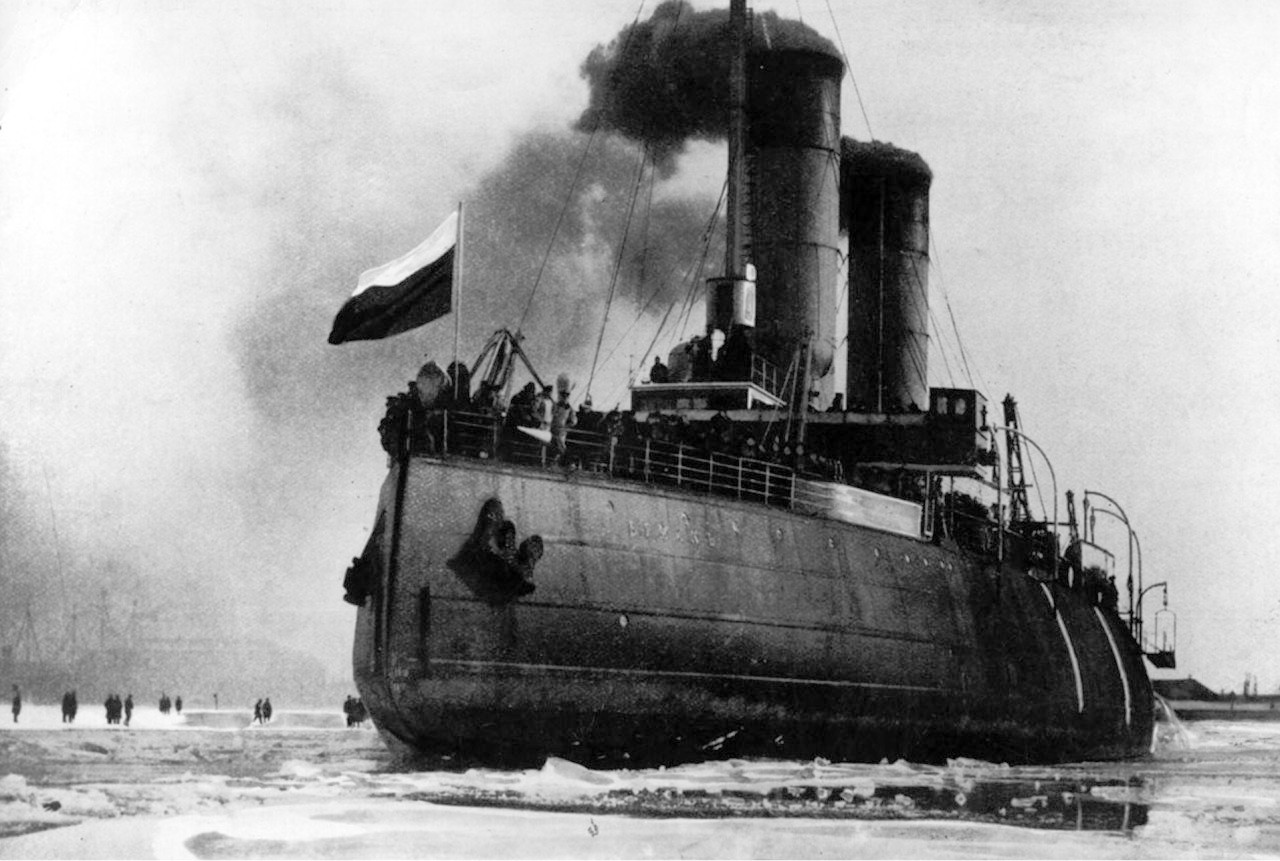
Yermak (1898 icebreaker)
- Type
- Icebreaker
- Period
- 19th Century
- Nation
- Russia
Overview: Yermak was a Russian and later Soviet icebreaker built in 1898, widely regarded as the first true polar icebreaker, with a strengthened hull specifically shaped to ride up onto pack ice and crush it under the vessel's weight. The design was overseen by Vice-Admiral Stepan Makarov with a commission that included chemist Dmitry Mendeleev and engineers N. I. Yankovsky and R. I. Runeberg. Specifications: She was built of steel with a reinforced bow section of roughly 29mm plate sandwiched with oak and cork, allowing her to break ice over 7 feet thick. Per Wikipedia's infobox, displacement was about 8,730 tons, length 97.5 m, beam 21.6 m, draught 7.3 m, with four shafts driven by eight vertical triple-expansion steam engines and six boilers producing roughly 9,000 hp for a speed of 12 knots; her twin tall funnels and round, sloping bow made her instantly recognizable and became a template for later icebreaker design. Service History: Yermak was constructed at Armstrong Whitworth's Low Walker yard on the Tyne, launched on 17 October 1898, and completed/acquired in 1899 for the Imperial Russian Navy. In 1898 she steamed into the Barents Sea attempting to reach the North Pole; although she fell short of that goal, the voyage reaching 81°21'N north of Spitsbergen demonstrated that a purpose-built icebreaker could operate in ice-choked seas previously closed to shipping, and she went on to serve the Russian/Soviet navy and merchant marine for decades before being taken out of service in 1963 and scrapped in 1964. Notable Facts: Her military value was demonstrated during the Russo-Japanese War, and a devoted student of Makarov's who sailed on her early voyages, Konstantin von Schultz, later died alongside Makarov when the battleship Petropavlovsk was sunk by Japanese mines. A 1:100 scale model of Yermak in her original 1899 configuration is on permanent display at the International Maritime Museum Hamburg, making it a useful modern reference for modelers alongside the surviving pre-1917 photographs.
Kits of this ship
No kits linked yet.
Plans
+ Suggest a plan setNo plan sets listed yet.
Links go to the publisher's or museum's own page. Ship Modelers Database lists plan sets; it doesn't host or display the drawings.
Build Logs
+ Link a build logNo build logs linked yet.
Resources
+ Submit a resource- Graces Guide: Yermak (icebreaker)Article
Engineering-trade-press-derived summary (from 1899 Engineering magazine) covering builder, design commission, and service life, useful for build-era technical context.
- Tyne & Wear Museums: The icebreaker Ermack, a great Tyne-built shipArticle
Museum blog from the Tyne-side builder's region describing hull strengthening and ice-crushing method, with reference to a period painting of the ship breaking ice.
- Wikimedia Commons: Yermak icebreaker.jpgMuseum
Pre-1917 photograph of Yermak flying the old Russian merchant flag; public domain, useful as a direct visual reference for hull and superstructure details.
- Wikipedia: Yermak (1898 icebreaker)Article
Main reference with full specifications (dimensions, displacement, propulsion), build history, and service timeline through scrapping in 1964.