 Ship Modelers Database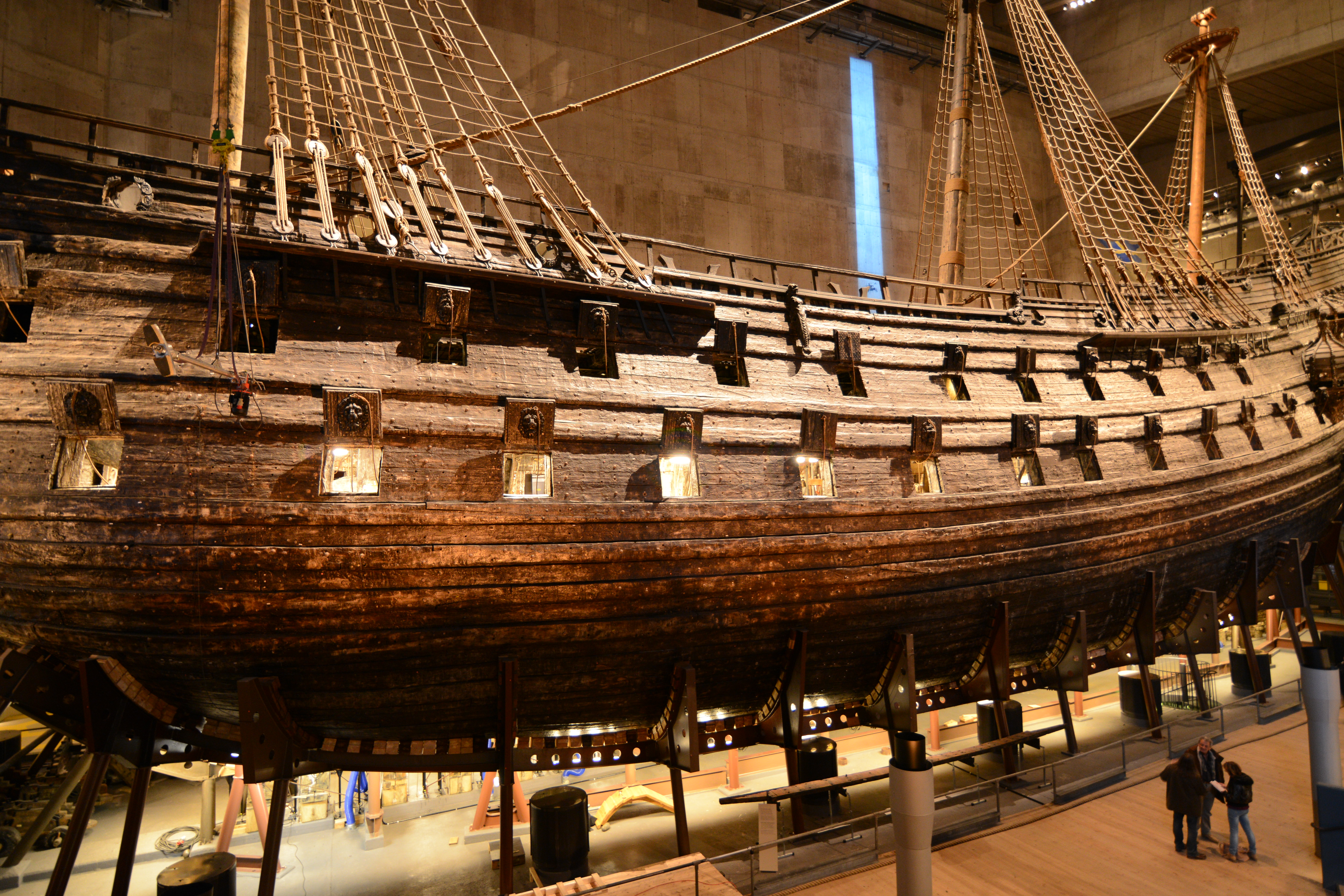
Vasa
- Type
- Ship of the Line
- Period
- 17th Century
- Nation
- Sweden
Overview: Vasa is a Swedish warship built between 1626 and 1628 on the orders of King Gustavus Adolphus (Gustav II Adolf) as part of a naval buildup during the war with Poland-Lithuania. Intended as one of the most powerful and lavishly decorated warships of the era, she famously sank on her maiden voyage in Stockholm harbor and is today the star exhibit of the Vasa Museum, the world's only well-preserved 17th-century ship. Specifications: The ship measured roughly 69 m (226 ft) in sparred length with a beam of 11.7 m (38 ft), a draft of about 4.8 m (16 ft), and displaced around 1,210 tonnes. She carried 64 guns across two gun decks, including forty-eight 24-pounders, eight 3-pounders, two 1-pounders, and six howitzers, with a complement of 145 sailors and 300 soldiers. She was a three-masted, four-decked vessel richly adorned with carved and gilded sculptures in the Dutch grotesque style, depicting mermaids, sea monsters, and other figures symbolizing royal authority. Vasa was an early example of a warship with two full-length gundecks, built at a time when the theoretical principles of shipbuilding were still poorly understood, making the two-deck arrangement a difficult compromise between seaworthiness and firepower. Service History: Vasa sank after sailing only about 1,300 m (1,400 yd) into her maiden voyage on 10 August 1628, capsizing in full view of a crowd of onlookers after a gust of wind caused her to heel over and take on water through her open gunports. The disaster, which killed roughly 30 people, was caused by a top-heavy, unstable design resulting from an overly narrow hull combined with heavy cannon armament and excessive decoration added under royal pressure for a rapid, imposing launch. Notable Facts: Most of Vasa's valuable bronze cannons were salvaged in the 17th century before she fell into obscurity, but she was rediscovered in the late 1950s and raised nearly intact in 1961 after 333 years on the seabed, an operation credited to researcher Anders Franzén. The cold, brackish, low-oxygen waters of the Baltic preserved the hull remarkably well, with roughly 98 percent of the ship remaining original material. She was displayed in a temporary museum until 1988 before moving to the purpose-built Vasa Museum in Stockholm, which by 2025 had drawn over 45 million visitors, making the ship one of the most studied and popular preserved vessels in the world for scale modelers and historians alike.
Kits of this ship
No image | Wasa (BB490) | Billing Boats | 1:75 | Available |
No image | Wasa, 17th C. Warship (SM13) | Corel | 1:75 | Available |
No image | Vasa Man of War (737) | Sergal (Mantua Model Group) | 1:60 | Available |
No image | Swedish Warship Vasa (Modelcraft/Elite) | Artesania Latina | 1:65 | Available |
Build Logs
+ Link a build log- Vasa build of Corel kit [COMPLETED BUILD]Edmund · Ships of Scale(Wasa, 17th C. Warship (SM13))
Completed build log for a Corel Vasa kit with detailed rigging and cannon-fitting progress documented.
- Wasa by Corelunknown (thread starter) · Ships of Scale(Wasa, 17th C. Warship (SM13))
Appears to be an active in-progress Corel Wasa planking build with commenters following along, though builder username unclear.
- Build Log: Corel Wasa SM13unknown (thread starter) · Ships of Scale(Wasa, 17th C. Warship (SM13))
Build log for a father's unfinished Corel SM13 Wasa kit being continued by a new builder, with progress questions and photos posted.
- Corelunknown (thread starter) · Ships of Scale(Wasa, 17th C. Warship (SM13))
Generic-titled thread showing progress photos of a Corel Wasa build, but ambiguous whether it's a genuine dedicated build log or discussion thread.
- Corel Vasa - bashedmd1400cs · Ships of Scale(Wasa, 17th C. Warship (SM13))
Build log documenting a heavily modified/bashed Corel Vasa, same builder as the MSW 'md1400cs' thread but a separate SOS log.
- Corel Wasa (Vasa), 1628 - Swedish Royal Warship of 64 guns, 1:75unknown (thread starter) · Ships of Scale(Wasa, 17th C. Warship (SM13))
Builder documents starting the Corel Vasa kit, listing references and discussing kit accuracy/color choices as construction begins.
- VASA 1628 (De Agostini)unknown (thread starter) · Ships of Scale
Build log for a 1:65 De Agostini Vasa kit build using upgraded pear wood parts and detail modifications.
- Wasa buildunknown (thread starter) · Ships of Scale(Wasa (BB490))
In-progress Wasa build log with hull-shaping progress photos and commentary on historically accurate ship colors.
- Vasa Build Log - Billing Boats - Scale 1/75 [COMPLETED BUILD]Peter G · Ships of Scale(Wasa (BB490))
Completed catch-up build log for the Billing Boats Vasa, explicitly documenting construction progress after a museum visit inspired the build.
Resources
+ Submit a resource- Vasa (ship) - WikipediaWebsite
Comprehensive overview of the ship's history, construction, sinking, salvage, and specifications useful for scale modelers.
- Wikimedia Commons: Vasa (ship, 1627) categoryWebsite
Large collection of free-to-use photographs of the preserved ship, its details, figurehead, and interior, useful for modeling reference.
- Vasa - A fully intact 17th century warship that was salvaged (Commons file)Website
CC BY 2.0 licensed photograph of the preserved hull as displayed in the Vasa Museum.
- Vasa Museum — Official WebsiteMuseum
The official Vasa Museum site with access to the ship's history, exhibitions, audio guides, and shop of accurate replica items, useful as a primary authoritative reference for modelers.
- The Vasa Model (1:10 scale) — Vasa Museum ExhibitionMuseum
Describes the museum's own 1:10 scale painted model of Vasa as she looked when she sailed in 1628, useful as a color/rigging/decoration reference built by professional model makers.
- His Majesty's Ship — Vasa Museum ExhibitionMuseum
Museum exhibition page covering the ship's construction, sinking, and subsequent trial, with a scale model depicting the moment of the shipwreck useful for context on the ship's early history.
- Vasa Museum — Wikipedia (background on the museum's archaeological publications)Website
Explains that the museum has been publishing a multi-volume archaeological report, including Vasa I: The Archaeology of a Swedish Warship of 1628 (2006) and Vasa II Part 1: Rigging and sailing a Swedish warship of 1628 (2023), both key scholarly sources for accurate construction and rigging details.
- Wasa 1626-1628 Warship Model Plans (7-sheet set)Plans
A 7-sheet set of ship model plans covering the parts and details needed to build a scale model of Vasa, useful as a practical build plan set.
- Full-scale Finite Element Modelling and Analysis of the 17th-century Warship VasaArticle
A technical paper describing a detailed geometrical/structural 3D model of Vasa built from geodetic and hand measurements by the museum, useful for understanding the precise hull geometry and construction layers (keel, three-layer hull, deck beams).