 Ship Modelers Database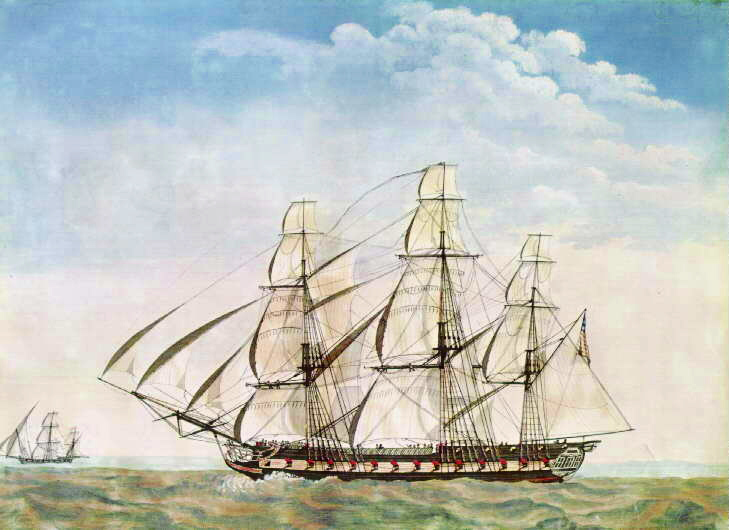
USS Essex
- Type
- Frigate
- Period
- 18th Century
- Nation
- United States
Overview: USS Essex was a 32-gun (sometimes rated 36-gun) fifth-rate sailing frigate built by public subscription in Salem, Massachusetts, and is remembered as one of the fastest and most graceful frigates of the early U.S. Navy. She is especially notable among modelers for her long, eventful career under three different flags of conflict (Quasi-War, Barbary War, War of 1812) and her dramatic single-ship-versus-two-ship final battle. Specifications: Essex displaced roughly 850 long tons, measured about 138 ft 7 in overall with a 37 ft 3.5 in beam and 12 ft 3 in draft, and was rigged as a full-rigged ship. Her American armament was 40 32-pounder carronades plus 6 12-pounder guns, while under British service after capture she carried 26 18-pounder guns on the upper deck plus carronades and 9-pounder guns on the quarterdeck and forecastle. She was designed by William Hackett and built by Enos Briggs at a cost of $139,362 raised by the people of Salem and Essex County. Service History: Commissioned on December 17, 1799, she became the first U.S. Navy warship to double the Cape of Good Hope to protect merchant ships to the East Indies during the Quasi-War with France, and went on to protect American trade during the First Barbary War. During the War of 1812, besides capturing HMS Alert that August, she had great success deterring the British whaling fleet and became the first U.S. Navy warship in February 1813 to sail into the Pacific Ocean. In January 1814 Essex sailed into neutral waters at Valparaiso, Chile, only to be trapped there for six weeks by the British frigates Phoebe and Cherub; Porter tried to gain the open sea but a heavy squall crippled the ship, and the enemy attacked the disabled vessel in what became one of the most remarkable engagements in naval history, ending in surrender after the loss of 155 men. Notable Facts: After capture, Essex was repaired by the British, sent to England, served as a prison ship at Kingston, Jamaica, in 1833, and was ultimately sold at public auction on 6 June 1837. Because she fought her final battle armed almost entirely with short-range carronades against opponents with longer-ranged guns, the Battle of Valparaíso is a frequently cited case study in the tactical limits of carronade-heavy armament, a detail worth reflecting in any diorama or rigging choices for a model depicting her last action.
Kits of this ship
| USS Essex | Model Shipways | 1:76 (OO) | Available |
Build Logs
+ Link a build logNo build logs linked yet.
Resources
+ Submit a resource- USS Essex (1799)Wikipedia Entry
- Wikipedia: USS Essex (1799)Website
Overview article with full specifications, armament, launch/capture dates, and service record; a solid general reference for a modeler.
- NHHC DANFS: Essex I (Frigate)Museum
Official U.S. Navy history entry (Dictionary of American Naval Fighting Ships) covering Essex's construction, cruises, and capture at Valparaiso.
- Ships of Scale: Frigate USS Essex 1799 General InformationArticle
Modeler-focused forum thread listing original Hackett draughts, Peabody Museum paintings, and published plan/reference books (Baker, Chapelle, Takakjian) useful for building an accurate model.
- Wikimedia Commons: Frigate-essex-1799.jpgWebsite
Source of the historical illustration used for this record, hosted on Wikimedia Commons under a free/public-domain license.