 Ship Modelers Database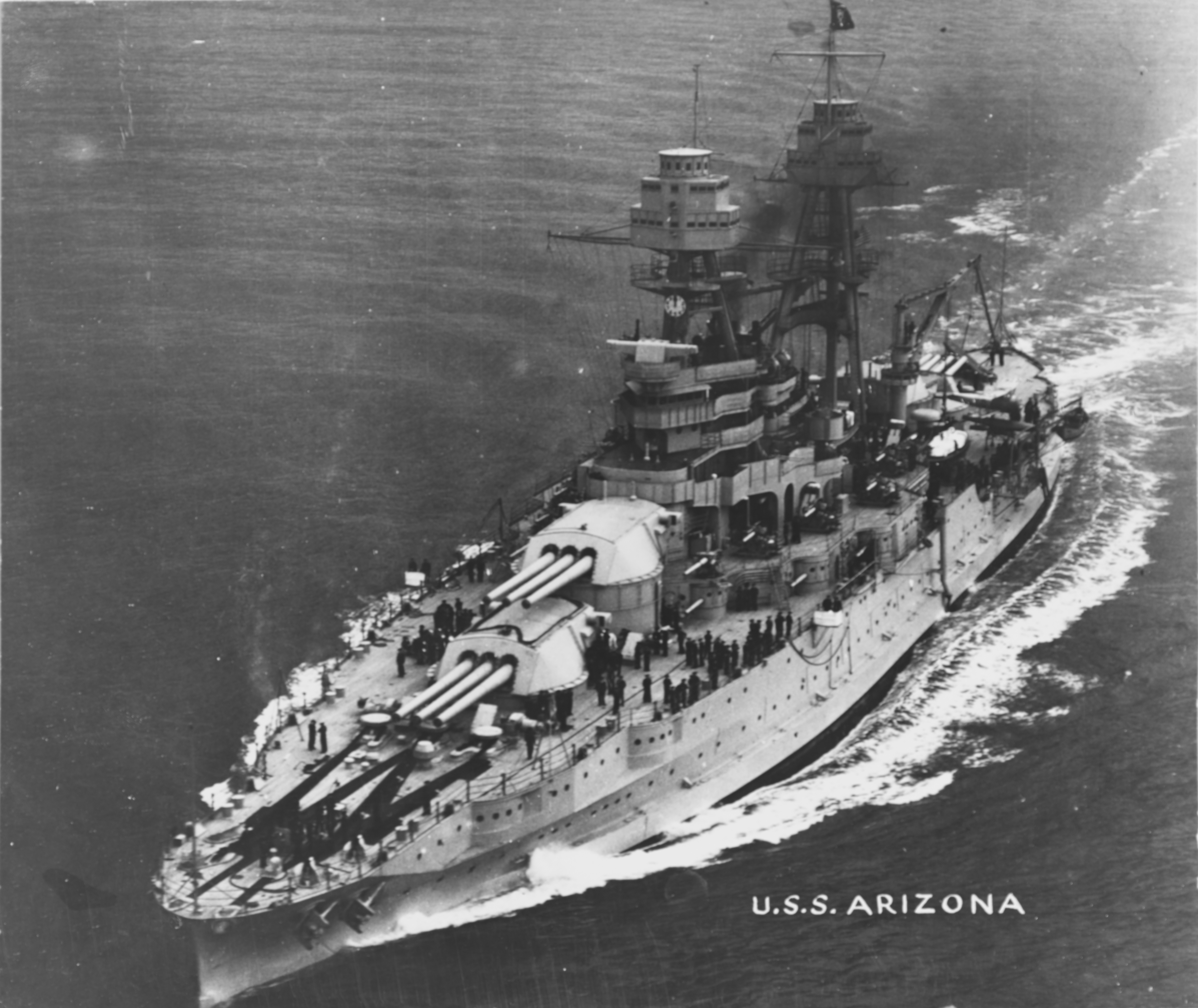
USS Arizona (BB-39)
- Type
- Battleship
- Period
- 20th Century
- Nation
- United States
Overview: USS Arizona (BB-39) was the second and last of the Pennsylvania-class super-dreadnought battleships built for the U.S. Navy. She is world-famous as the ship whose catastrophic loss during the Japanese attack on Pearl Harbor on December 7, 1941, symbolized America's entry into World War II, and her wreck remains a war grave beneath the USS Arizona Memorial in Hawaii. Specifications: Arizona had an overall length of 608 feet (185.3 m), a beam of 97 feet (29.6 m), and a draft of about 29 feet 3 inches (8.9 m) at deep load, displacing roughly 29,000 long tons. Her main armament comprised 4 triple 14-inch (356 mm) gun turrets, supplemented by numerous 5-inch secondary guns, 3-inch anti-aircraft guns, and torpedo tubes, with armor belts up to 13.5 inches thick. Service History: Built at the Brooklyn (New York) Navy Yard, she was laid down in 1914, launched in 1915, and commissioned in October 1916. She served stateside during WWI as a gunnery training ship, escorted President Wilson to the Paris Peace Conference in 1918, was modernized at Norfolk Navy Yard in 1929-31, and was later based in the Pacific, ultimately moored at Pearl Harbor's "Battleship Row" when the Japanese attacked on December 7, 1941. Notable Facts: During the attack, Arizona was struck by several bombs, one of which detonated her forward ammunition magazines, wrecking the ship's forward hull and collapsing her forward superstructure, killing 1,177 of her crew. Unlike most other vessels damaged that day, Arizona could not be salvaged; her hull still rests on the harbor floor and the USS Arizona Memorial, dedicated in 1962, straddles the wreck. Various salvaged artifacts, including guns and fittings, are displayed at sites across the United States, offering additional reference detail for modelers.
Kits of this ship
No kits linked yet.
Build Logs
+ Link a build logNo build logs linked yet.
Resources
+ Submit a resource- USS Arizona BB-39 Booklet of General Plans Drawings (1941 & 1924/modernized sets)Plans
Site hosts two full scanned BOGP sets — a 1941 version and a 1924 set later annotated for the 1929-31 modernization — useful for comparing pre- and post-refit configurations.
- USS Arizona BB-39 (1930) Hull Lines & Body Plan with Anti-Torpedo BlistersPlans
Builder's drawing from Norfolk Navy Yard showing forward hull lines and body plan including the anti-torpedo blisters added during the 1930-31 reconstruction, useful for accurate underwater hull shape.
- USS Arizona (BB-39) Booklet of General Plans (1941, Navy Yard Puget Sound)Plans
Official U.S. Navy General Arrangement/Deck plans showing Arizona largely as she was at the time of her loss, ideal for accurate hull and superstructure detailing.
- USS BB-39 Arizona (Battleship) 1941 BlueprintsPlans
Downloadable line-drawing blueprint set depicting the 1941 configuration, handy quick-reference profile/plan views for modelers.
- USS Arizona (BB-39) Wreck Site—1941 (Naval History and Heritage Command)Article
Official Navy underwater archaeology page detailing the wreck's history and NPS/Navy 3D-modeling and photo-documentation efforts, useful for understanding the ship's final as-sunk condition.
- Pearl Harbor National Memorial (National Park Service)Museum
Official NPS site for the memorial built over Arizona's hull, with visitor information, exhibit details, and historical resources maintained by the agency responsible for the wreck site.
- The Battleship USS Arizona (Super Drawings in 3D)Book
Kagero 'Super Drawings in 3D' volume with detailed multi-angle 3D renderings of the ship, widely recommended by modelers for improving detail accuracy on kits or scratch-builds.
- USS Arizona (BB-39) Photographic History PageMuseum
Naval History and Heritage Command page with archival photographs and service history spanning her commissioning through her loss at Pearl Harbor, useful for period detail reference.
- Exploring the USS Arizona Wreck — Secrets of Pearl Harbor Revealed After 75 YearsVideo
Video documentary using modern scanning technology to explore the sunken hull, giving modelers visual reference for the ship's current wreck-state structure and details.