 Ship Modelers Database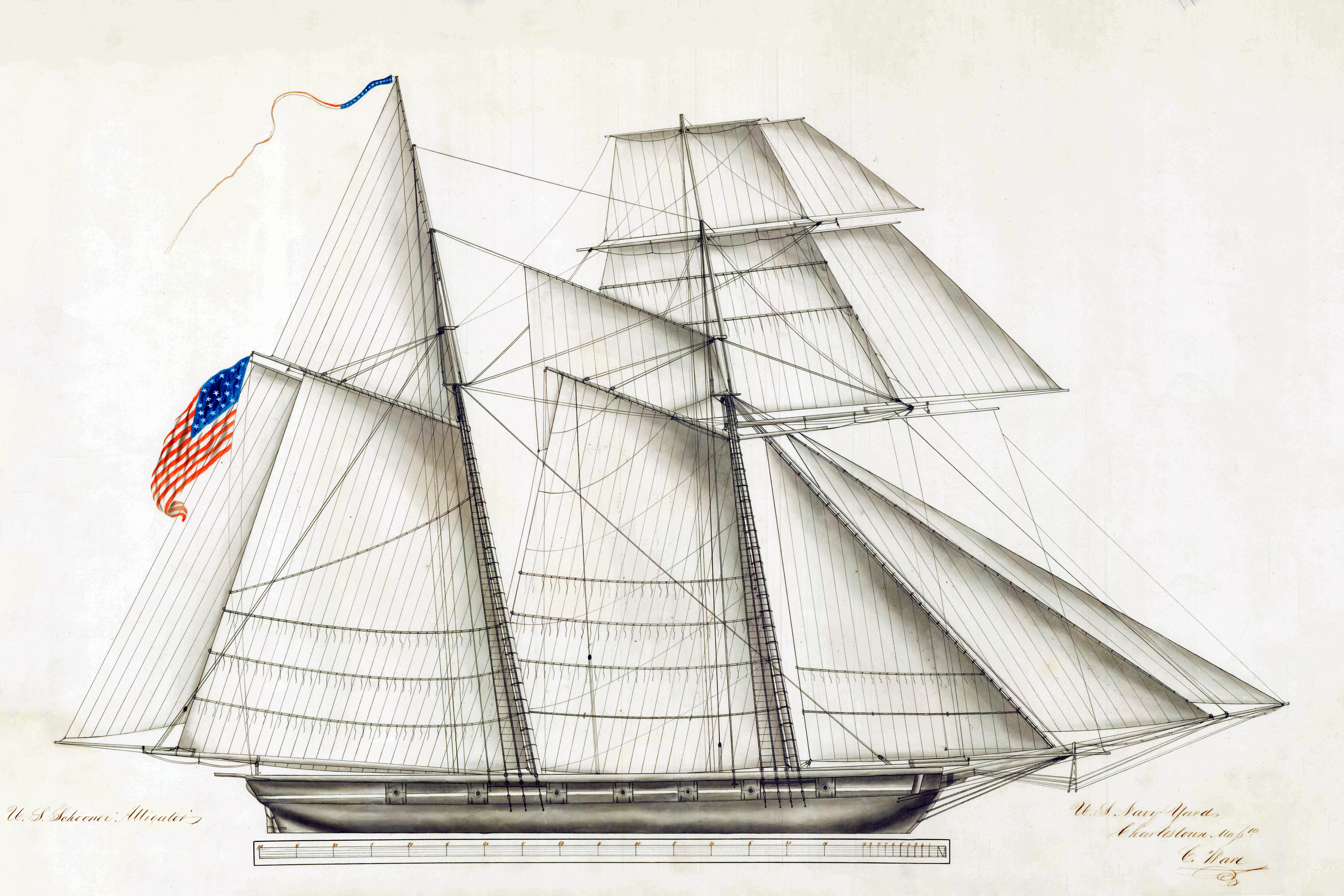
USS Alligator
- Type
- Schooner
- Period
- 19th Century
- Nation
- United States
Overview: USS Alligator (1820) was a topsail schooner of the United States Navy, one of five small, fast schooners built to suppress piracy and the illegal slave trade in the early 1820s. She is best remembered for the role her commanding officer played in acquiring the territory that became Liberia, and for her dramatic end on a Florida reef that still bears her name. Specifications: The ship was built at the Boston (Charlestown) Navy Yard, launched 2 November 1820, and measured about 86 feet in length with a 24 ft 7 in beam and roughly 198 tons burthen. She carried a single pivoting 18-pounder gun plus around ten to twelve 6-pounder carronades. Naval architect William Doughty gave her a steep deadrise and forward rake that made her fast and weatherly, and she was heavily built with live-oak frames, white-oak planking, locust treenails, and copper sheathing below the waterline, ballasted with iron kentledge rather than the usual stone. Service History: Commissioned in March 1821 under Lieutenant Robert F. Stockton, Alligator's first cruise took her to West Africa to interdict slave ships and to help secure land for the American Colonization Society, a mission that led to the founding of the colony that became Liberia. She captured several slaving vessels during that cruise. In 1822 she was reassigned to the West Indies to fight piracy, capturing the pirate schooner Cienega and later fighting a sharp action to recover captured American vessels near Cuba before running hard aground on a reef off the Florida Keys on 19 November 1822; unable to refloat her, the crew burned the wreck on 23 November 1822 to keep her from falling into pirate hands. Notable Facts: The reef where she was lost is now named Alligator Reef in her honor, and the wreck site was added to the National Register of Historic Places in 1996. Surviving ballast piles and lower-hull remains are preserved in situ as a protected archaeological site, and a period plan of her spars and sails by C. Ware, held by the National Archives, is one of the best surviving technical references for modelers.
Kits of this ship
No kits linked yet.
Build Logs
+ Link a build logNo build logs linked yet.
Resources
+ Submit a resource- USS Alligator (1820) - WikipediaWebsite
Overview article with basic specifications, service history, and fate of the 1820 schooner.
- NHHC: USS Alligator Potential Wreck Site (1822)Museum
Detailed construction and archaeological description including hull materials, ballast, and armament, useful for modelers wanting accurate build details.
- DANFS: Alligator III (Schooner)Article
Official Dictionary of American Naval Fighting Ships entry covering the ship's full service history.
- NPS: USS Alligator ShipwreckArticle
National Park Service summary of the wreck site and its condition today, useful for vessel status context.
- NOAA Florida Keys: USS AlligatorMuseum
NOAA Sanctuary page with construction details, armament, and a period drawing credited to the National Archives.
- Wikimedia Commons: USS Alligator.jpgMuseum
High-resolution period plan/drawing of the schooner used as the Wikipedia infobox image, sourced from National Archives holdings.