 Ship Modelers Database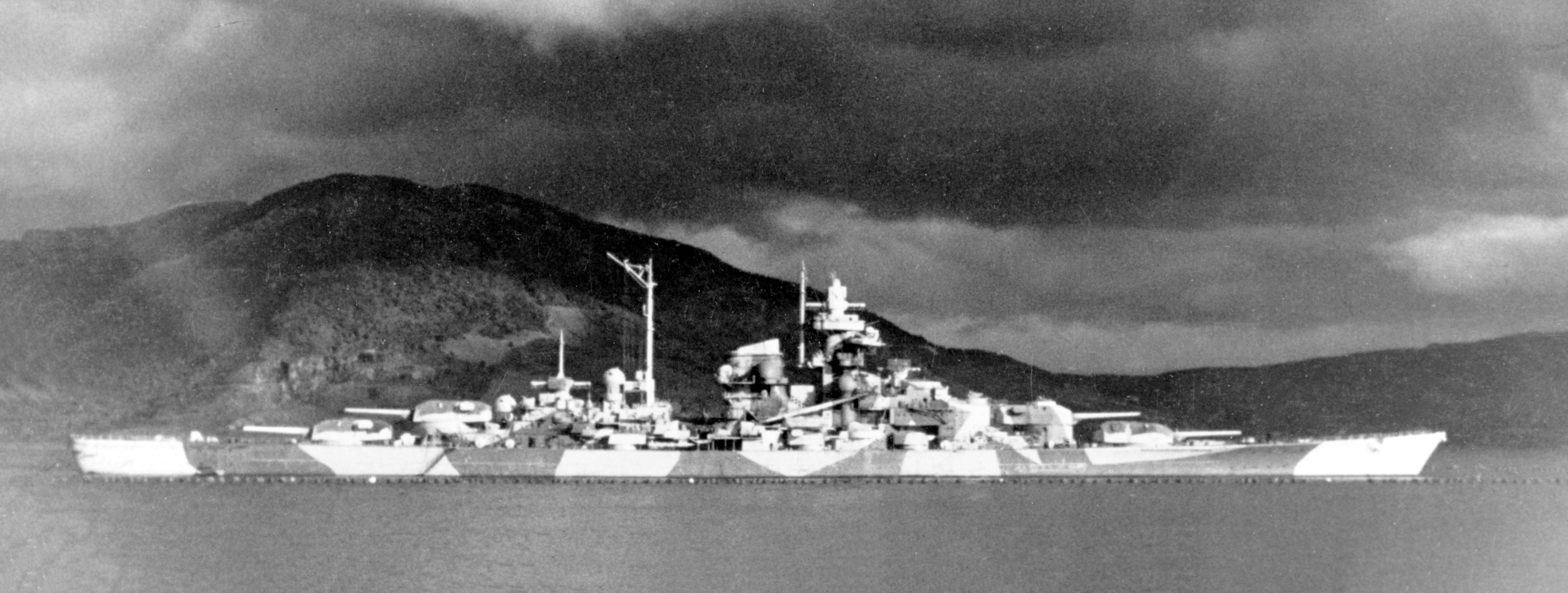
Tirpitz
- Type
- Battleship
- Period
- 20th Century
- Nation
- Germany
Overview: Tirpitz was the second of two Bismarck-class battleships built for Nazi Germany's Kriegsmarine, and operated for most of her career as a "fleet in being" in Norwegian fjords, where she tied down significant British naval resources by threatening Arctic convoys to the Soviet Union rather than through direct combat. Specifications: She displaced 42,900 t standard and 52,600 t at full load, with an overall length of 251 m, beam of 36 m, and a draft of around 9.3–10.6 m depending on load. Her main battery comprised eight 38 cm guns in four twin turrets, supported by twelve 15 cm secondary guns; her belt armor was 320 mm thick and turret faces 360 mm. Uniquely among her class, Tirpitz was later fitted with two banks of quadruple 53.3 cm torpedo tubes carrying 24 torpedoes, and after wartime modifications she became roughly 2,000 tonnes heavier than Bismarck, making her the heaviest battleship built by a European navy. Service History: Laid down at the Kriegsmarinewerft in Wilhelmshaven in late 1936 and commissioned in February 1941, Tirpitz briefly served with a Baltic Fleet formed to deter a Soviet breakout before deploying to Norway in January 1942 to threaten Allied convoys and deter invasion. She conducted sortie attempts against convoys in 1942, bombarded Allied positions on Spitzbergen in September 1943 (her only offensive use of the main battery), and was damaged later that month by the Operation Source midget-submarine raid, which disabled her for roughly six months. Further air attacks culminated in Operation Tungsten (April 1944) and subsequent Tallboy bombing raids that progressively crippled the ship. Notable Facts: Tirpitz was finally destroyed on 12 November 1944 in Operation Catechism, when RAF Lancasters dropped Tallboy bombs that capsized her near Tromsø with heavy loss of life among her roughly 1,700-man crew that day. Relics from the wreck — including a crew-painted bulkhead section — are preserved at the RAF Museum Hendon, and other artifacts are displayed in Norwegian museums including the Tirpitz Museum near Alta.
Kits of this ship
No kits linked yet.
Build Logs
+ Link a build logNo build logs linked yet.
Resources
+ Submit a resource- Wikipedia: German battleship TirpitzArticle
Comprehensive overview of design, specifications, and service history, useful baseline reference for modelers.
- Wikipedia: List of Allied attacks on the German battleship TirpitzArticle
Details the numerous Allied raids and attacks on Tirpitz culminating in her sinking, useful for understanding her wartime appearance changes (camouflage nets, damage).
- Wikimedia Commons: German Battleship Tirpitz.jpgMuseum
Public domain historical photograph of the battleship, suitable for reference imagery in a modeling database.
- Wikipedia: Bismarck-class battleshipWebsite
Covers class-wide design details and comparisons between Bismarck and Tirpitz, including torpedo armament unique to Tirpitz and post-war scrapping fate.
- Wikipedia: Operation CatechismArticle
Detailed account of the final RAF Tallboy raid that sank Tirpitz on 12 November 1944, including casualty figures and aftermath.
- Wikimedia Commons: Tirpitz in Bogen Bay, OfotfjordMuseum
Public-domain U.S. Naval Historical Center photograph (NH 71390) showing Tirpitz at anchor in a Norwegian fjord, useful as a visual reference for hull and camouflage.