 Ship Modelers Database
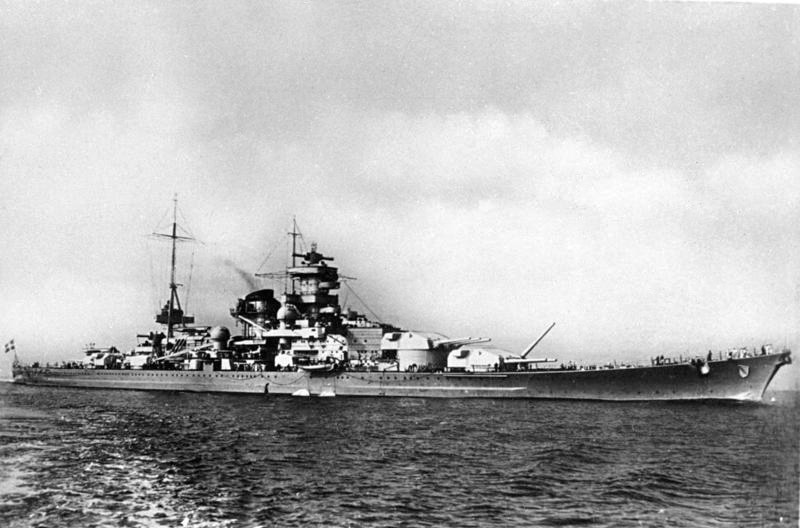
Image: CC BY-SA 3.0 DE · commons.wikimedia.org
Scharnhorst
Sunk
Scharnhorst was a German capital ship of Nazi Germany's Kriegsmarine, often described as either a battleship or a battlecruiser, and was lead ship of the two-vessel Scharnhorst class along with her sister Gneisenau. She was one of the first capital ships built for Germany after the Treaty of Versailles and became one of the most famous German surface raiders of World War II.
Kits of this ship
+ Add a kit| Scharnhorst (Vintage Classics) | Airfix | 1:600 | Injection-Molded Plastic | Available | |
No image | German Battleship Scharnhorst 1943 | Flyhawk | 1:700 | Injection-Molded Plastic | Discontinued |
| German Battle Cruiser Scharnhorst | Tamiya | 1:700 | Injection-Molded Plastic | Available | |
| German Scharnhorst Battleship (1/200) | Trumpeter | 1:200 | Injection-Molded Plastic | Available | |
No image | German Battlecruiser Scharnhorst 1943 Deluxe Edition | Flyhawk | 1:700 | Injection-Molded Plastic | — |
| German Scharnhorst Battleship (1/700, 2012 new tool) | Trumpeter | 1:700 | Injection-Molded Plastic | Available | |
| German Battleship Scharnhorst 1943 Smart Kit | Dragon (DML) | 1:350 | Injection-Molded Plastic | Discontinued | |
| German Battleship Scharnhorst 1941 Smart Kit | Dragon (DML) | 1:350 | Injection-Molded Plastic | Available | |
No image | German Battleship Scharnhorst 1943 | Trumpeter | 1:350 | Injection-Molded Plastic | Available |
| Battleship Scharnhorst | Revell of Germany | 1:1200 | Injection-Molded Plastic | Available | |
No image | German Battleship Scharnhorst 1940 Smart Kit | Dragon (DML) | 1:350 | Injection-Molded Plastic | Discontinued |
Plans
No plan sets listed for this ship yet. Know of museum, archive or publisher drawings? Add them so the next builder can find them.
Links go to the publisher's or museum's own page. Ship Modelers Database lists plan sets; it doesn't host or display the drawings.
Build logs
+ Link a build logNo build logs linked yet.
Resources
+ Submit a resourceHistory & specifications
- Wikipedia: Battle of the North CapeArticle
Detailed account of the final battle in which Scharnhorst was sunk, useful for diorama or display context.
- Wikipedia: German battleship ScharnhorstWebsite
Primary reference covering design, armament, and full service history including her final battle.
- Wikipedia: Scharnhorst-class battleshipWebsite
Class-level design and armament details useful for comparing Scharnhorst and Gneisenau for modeling purposes.
Photos
- Wikimedia Commons: Bundesarchiv photo of battleship ScharnhorstPhoto
Open-licensed wartime photograph of Scharnhorst from the German Federal Archives, useful as a visual reference for hull and superstructure details.
History
Specifications
She displaced 32,100 long tons standard and 38,100 long tons at full load, measured 234.9 m long with a 30 m beam and 9.9 m draft, and could reach 31.5 knots on three Brown, Boveri & Cie geared steam turbines. Her main battery comprised nine 28 cm (11 in) guns in three triple turrets (two forward, one aft), with plans to up-gun her to six 38 cm guns never realized; secondary and AA armament included twelve 15 cm guns, fourteen 10.5 cm AA guns, and a growing battery of 3.7 cm and 2 cm light AA guns. A distinctive modeling feature is her "Atlantic bow," a raised clipper-style stem retrofitted after 1939 trials revealed the original straight stem shipped dangerous amounts of water.
Service history
Scharnhorst and Gneisenau raided Allied shipping in the Atlantic early in the war, and during the Norway campaign the pair sank the aircraft carrier HMS Glorious and her escorting destroyers, with Scharnhorst scoring one of the longest-range naval gunfire hits in history. In 1942 she made the famous "Channel Dash" from occupied France back to Germany, and in 1943 she moved to Norway to threaten Arctic convoys alongside the battleship Tirpitz. On 26 December 1943 she was brought to action and sunk at the Battle of the North Cape by the British battleship HMS Duke of York and supporting cruisers and destroyers, with only 36 of her nearly 2,000-man crew surviving.
Notable facts
Her sortie against HMS Rawalpindi in November 1939 and the dramatic Channel Dash of February 1942 are among her most-modeled moments, alongside her distinctive post-refit silhouette with raked funnel cap and enlarged aircraft hangar. The wreck lies upturned on the seabed off Norway's North Cape, discovered by a Royal Navy survey in 2000.