 Ship Modelers Database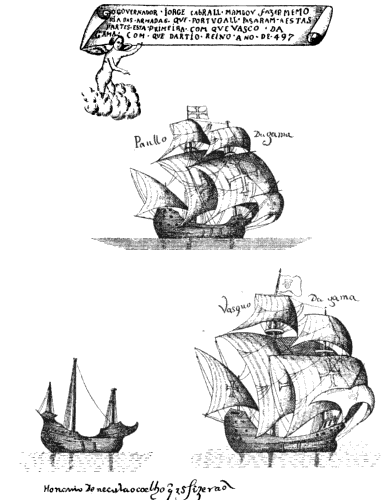
São Gabriel
- Type
- Carrack
- Period
- 15th Century
- Nation
- Portugal
Overview: São Gabriel was a Portuguese carrack and the flagship of Vasco da Gama's armada on his first voyage to India in 1497–1499. The ship holds a landmark place in maritime history as the vessel that opened the direct sea route from Europe to Asia around the Cape of Good Hope. Specifications: Modern estimates give a length of 25.7 m (84 ft 4 in), a beam of 8.5 m (27 ft 11 in), a draft of 2.3 m (7 ft 7 in), tons burthen of about 100 t, a complement of roughly 60, and an armament of 20 guns. Contemporary sources described her size as between 90-120t whereby it has to be considered that more modern estimates of tonnage tend to be higher than such determinations in the 16th century, with an estimated fully loaded weight of about 178t. Her guns were distributed with 20 guns, 6 placed in the two castles, and 8 on the lower quarterdeck. She was built from timber cut in the crown woods of Leiria and Alcácer do Sal. Construction and Design: The ship was constructed under the supervision of Bartolomeu Dias, who, having reached the Cape of Good Hope before, knew what type of vessel would be suited for the voyage. As a carrack, or Portuguese "nau," she was built specifically for this expedition alongside her sister ship, and carracks tended to be slower and less able to sail against the wind than the caravel, but were safer and more steady, and more comfortable for the crew. The vessel featured fore- and aftcastles that also housed the officers, with the captain quartered atop the aftcastle, while the forward hold stored spare sails and anchor along with midships water, and the aft held ammunition and arms. Service History: Da Gama departed from Lisbon on July 8, 1497, with a fleet of four vessels—two medium-sized three-masted sailing ships, each of about 120 tons, named the "São Gabriel" and the "São Rafael"; a 50-ton caravel, named the "Berrio"; and a 200-ton store ship. After rounding the Cape and reaching Malindi and Calicut, the return journey was harsh: on March 20 the "São Gabriel" and "Berrio" rounded the Cape together but a month later were parted by a storm, with the "Berrio" reaching the Tagus River in Portugal on July 10. Da Gama continued in São Gabriel to Terceira Island in the Azores, whence he is said to have dispatched his flagship to Lisbon, himself reaching Lisbon on September 9. Her ultimate fate afterward is unrecorded. Notable Facts: No contemporary images of the ship survive; the earliest are from about fifty years later, meaning most artistic depictions (including the Livro de Lisuarte de Abreu illustration) are retrospective rather than eyewitness records. The voyage was scientifically equipped, as the ship carried the latest scientific astronomical and nautical instruments, with navigational instruments and training provided by the astronomer Abraham Zacut. Disease took a heavy toll on the crew, and her sister ship São Rafael was ultimately scuttled and burned at Malindi due to crew losses rather than returning home.
Kits of this ship
No kits linked yet.
Build Logs
+ Link a build logNo build logs linked yet.
Resources
+ Submit a resource- Wikipedia: São Gabriel (ship)Website
Overview article with general characteristics table (dimensions, armament, crew) and voyage history, useful baseline reference for modelers.
- Shipstamps Forum: São Gabriel (Vasco da Gama)Article
Detailed write-up on construction, armament layout, and fittings of the São Gabriel, including specific dimensions and internal arrangement useful for modeling accuracy.
- Wikimedia Commons: SaoGabriel.png (from Livro de Lisuarte de Abreu)Museum
Public-domain 16th-century illustration of the São Gabriel from the Livro de Lisuarte de Abreu, the earliest known depiction of the ship and a key visual reference for modelers.