 Ship Modelers Database
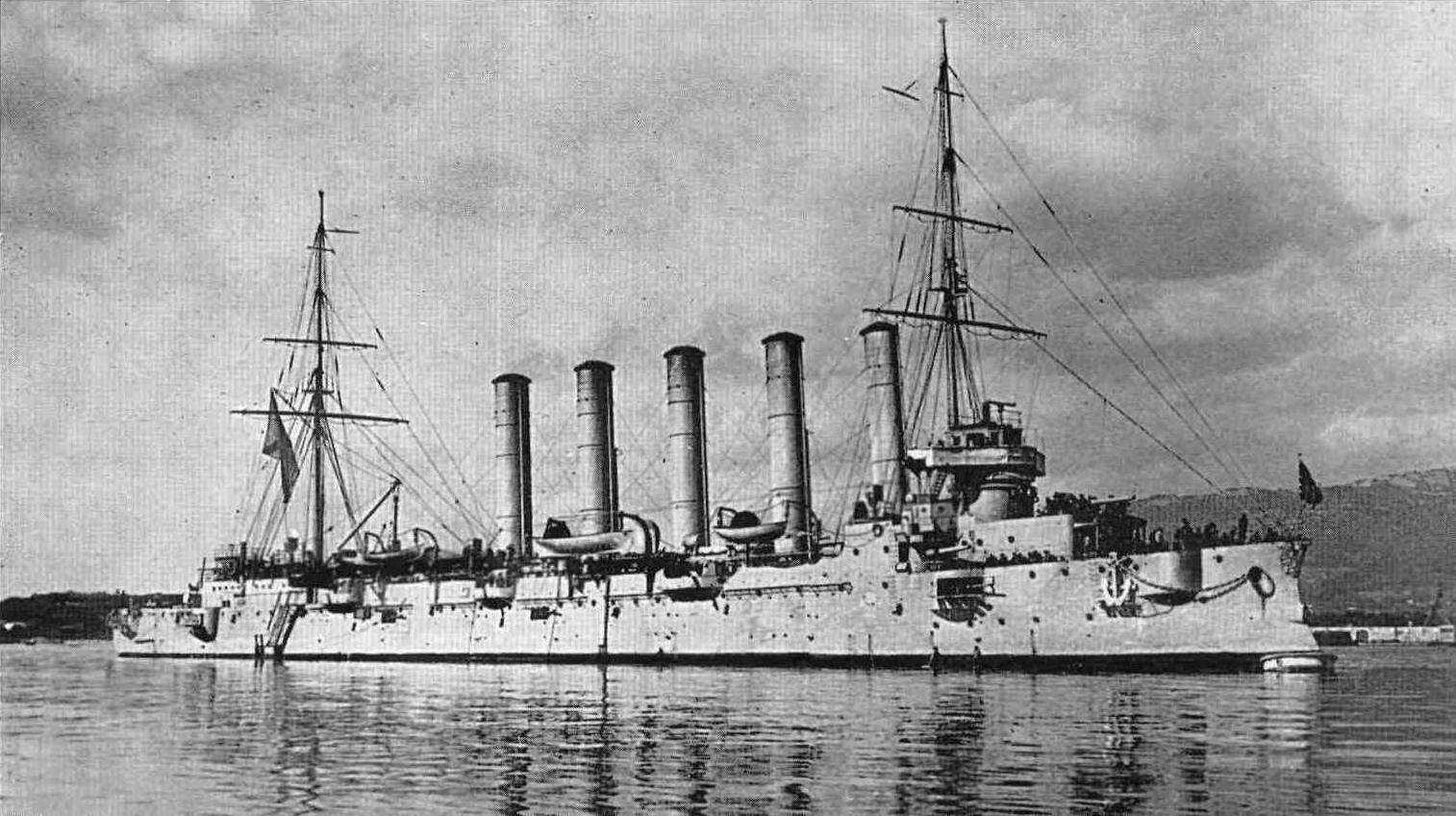
Image: Public domain · commons.wikimedia.org
Russian cruiser Askold
Scrapped
Askold was a protected cruiser built for the Imperial Russian Navy by the Germaniawerft yard in Kiel, Germany, one of three large protected cruisers (alongside Varyag and Bogatyr) ordered from foreign shipyards to bolster Russia's Pacific Fleet. She is immediately recognizable to modelers for her unusual five thin funnels, a silhouette unique among Imperial Russian Navy ships that led British sailors to nickname her "Packet of Woodbines" after a popular cigarette brand of the era.
Kits of this ship
+ Add a kit| Askold Cruiser Russia 1902 | Kombrig (Combrig) | 1:700 | Resin | Available | |
No image | Russian Cruiser "Askold" 1904 | Flagman | 1:350 | Resin | Discontinued |
No image | Rosyjski krążownik ASKOLD, monitor NOWGOROD | JSC | 1:400 | Card | Available |
Plans
No plan sets listed for this ship yet. Know of museum, archive or publisher drawings? Add them so the next builder can find them.
Links go to the publisher's or museum's own page. Ship Modelers Database lists plan sets; it doesn't host or display the drawings.
Build logs
+ Link a build logNo build logs linked yet.
Resources
+ Submit a resourceHistory & specifications
- Naval Encyclopedia: Protected Cruiser Askold (1900)Article
Detailed technical article covering hull design, armor layout, and armament specifics useful for scale modeling accuracy.
- Wikipedia: Russian cruiser AskoldWebsite
Comprehensive overview of the ship's design, specifications, and full operational history from 1902 to scrapping in 1922.
Museums & archives
- NHHC: Askold Photographed Interned at Shanghai, 1904Museum
Naval History and Heritage Command photograph record documenting the ship's appearance after the Battle of the Yellow Sea.
Photos
- Wikimedia Commons: Category Askold (ship, 1900)Photo
Collection of historical photographs, plans, and line drawings of the cruiser useful for visual reference when modeling.
History
Specifications
She displaced 5,910 tons full load, measured 132.5 m long with a 15 m beam and 6.2 m draught, and her triple-expansion engines gave a trial speed of 23.8 knots, making her reputedly the fastest of the larger Russian cruisers of her day. Main armament was 12 six-inch Canet guns plus a secondary battery of 75mm, 47mm and 37mm guns, Maxim machine guns, and six 15-inch torpedo tubes, protected by a turtleback armored deck of Krupp steel.
Service history
Commissioned in January 1902, Askold served with the Pacific Fleet at Port Arthur and survived the opening Japanese attack of the Russo-Japanese War in 1904 with only minor damage. At the Battle of the Yellow Sea she served as flagship of Rear Admiral Reitzenstein's cruiser squadron, took heavy damage breaking through the Japanese blockade, and was interned at Shanghai for the remainder of the war. She later became flagship of the Siberian Flotilla, and in World War I operated with Allied forces pursuing the German East Asia Squadron before serving in the Mediterranean off Syria and Palestine and supporting the Gallipoli landings.
Notable facts
After the February Revolution the crew pledged loyalty to the Provisional Government, and the ship was later seized by the Royal Navy in Kola Bay in 1918 and recommissioned as the depot ship HMS Glory IV. Offered back to Soviet Russia after the Civil War, she was found to be in such poor technical condition that she was instead sold for scrap and towed to Hamburg, where she was broken up in 1922.