 Ship Modelers Database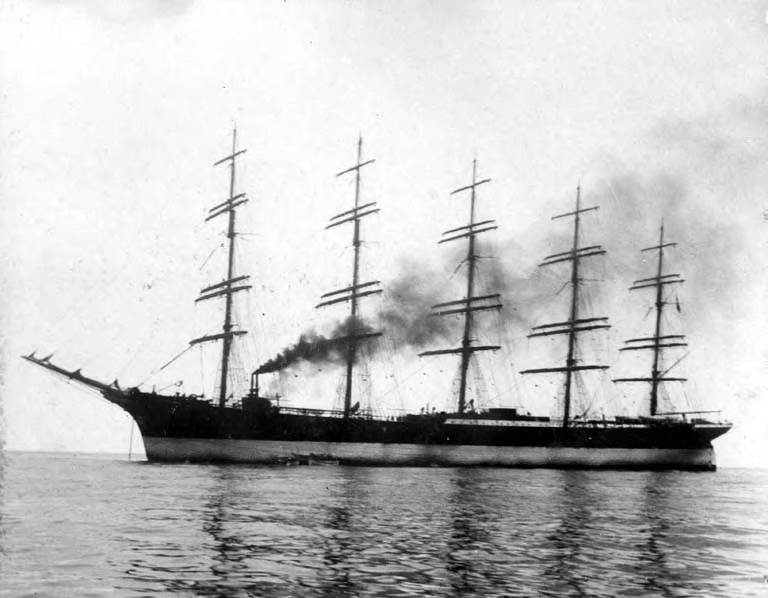
Preussen
- Type
- Five-Masted Full-Rigged Ship
- Period
- 20th Century
- Nation
- Germany
Overview: Preussen was a German steel-hulled, five-masted, full-rigged sailing ship built in 1902 for the F. Laeisz shipping company, named after the Kingdom of Prussia. She was the world's only five-masted vessel carrying six square sails on each mast, and remained the only five-masted full-rigged ship ever built until the 2000 launch of the sail cruise ship Royal Clipper, which was directly modeled on her design. Specifications: Built as hull number 179 at the Joh. C. Tecklenborg shipyard in Geestemünde to designs by Georg Wilhelm Claussen, she was constructed with a steel hull and watertight bulkheads. Contemporary accounts describe her carrying 47 sails (30 square sails in six storeys, 12 staysails between the five masts, four foresails (jibs) and a small fore-and-aft spanker), with a waterline length of 124 m and a total hull length of 132 m, a hull 16.4 m wide, a displacement of 11,150 long tons, and an effective carrying capacity of 8,000 long tons. She required an unusually large crew to manage her rig, including a double steering wheel that in heavy weather needed eight men to hold. Service History: Preussen entered service on her maiden voyage 31 July 1902 to Iquique, Chile in 64 days, primarily hauling nitrate cargoes between Chile and Germany via Cape Horn — over her career she made 13 nitrate voyages, loading between 7,729 and 7,998 metric tons of nitrate each trip. In November 1910 she was rammed in the English Channel by the cross-Channel steamer Brighton; after her anchor chains parted in rising wind and tugs could not hold her, she subsequently drifted ashore at Dover at about 16:30 and was lost, with no loss of life. A subsequent Admiralty Court inquiry found the Brighton and her master solely responsible for the collision. Notable Facts: The ship's design was conceived as an extension of the existing five-masted steel barque type (such as Potosi) into a fully square-rigged configuration; famously, Kaiser Wilhelm II, after touring the barque Potosi in 1899, reportedly asked F. Laeisz owner Carl Laeisz "Na, Laeisz, wann kommt denn nun das Fünfmastvollschiff?" (essentially, "so when is the five-masted full-rigger coming?"). Remnants of her wreck, including a few ribs, can reportedly still be seen off Crab Bay at low spring tides, and a model of the ship is held in the Deutsches Museum in Munich.
Kits of this ship
No kits linked yet.
Build Logs
+ Link a build logNo build logs linked yet.
Resources
+ Submit a resource- Wikipedia: Preussen (ship)Website
Overview article with specifications, service history, and loss details, a useful starting point for modelers.
- Wikimedia Commons: Vollschiff Preussen.pngMuseum
Public domain historical image of the ship under full sail, usable as a reference image for modelers.
- Company of Master Mariners Australia: Windjammer Preussen 1902Article
Narrative account of the ship's design, career, and 1910 collision and wrecking near Dover.
- Bruzelius Maritime Archive: Preussen (1902)Website
Detailed technical data including dimensions, tonnage, cargo loads per voyage, and a first-hand account of the 1910 collision and wrecking.
- Maritime Archaeology Trust: The PreussenArticle
Archaeological project page discussing the wreck site off Dover and the 1911 Admiralty Court findings on the collision.
- Shipmodell: PREUSSEN Windjammer 1902Website
Modeler-focused page with detailed rigging, sail plan, and construction specifications useful for building a scale model.
- Wikimedia Commons: German five-masted sailing vessel PREUSSEN at anchor, Washington, ca 1900 (Hester Collection)Museum
Public-domain historical photograph of Preussen at anchor from the Wilhelm Hester Photographs Collection, useful reference image for hull and rig details.