 Ship Modelers Database
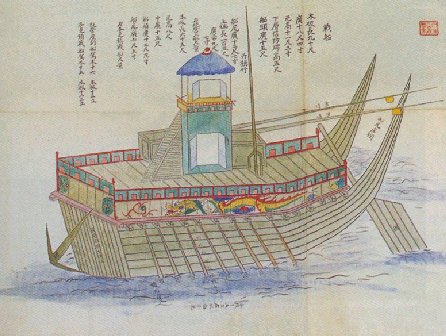
Image: Public domain · commons.wikimedia.org
Panokseon
No original examples survive; only museum replicas exist
The panokseon (board-roofed ship) was the standard-issue warship of the Joseon Navy from the mid-16th century, serving as the backbone fleet that fought off Japanese invasion fleets during the Imjin War (1592-1598) under Admiral Yi Sun-sin. It also served as the structural basis for the famous armored geobukseon (turtle ship).
Kits of this ship
+ Add a kit| 1/700 Korea Panokseon | Artist Hobby | 1:700 | Resin | Discontinued |
Plans
No plan sets listed for this ship yet. Know of museum, archive or publisher drawings? Add them so the next builder can find them.
Links go to the publisher's or museum's own page. Ship Modelers Database lists plan sets; it doesn't host or display the drawings.
Build logs
+ Link a build logNo build logs linked yet.
Resources
+ Submit a resourceHistory & specifications
- Wikipedia: PanokseonWebsite
Overview of the panokseon class, including dimensions, armament, construction, and comparison to Japanese warships, useful for general reference and dimensions.
Photos
- Wikimedia Commons: File:Panokseon.jpg (old painting of a Panokseon)Photo
Public domain reproduction of a period painting depicting a panokseon, useful as a visual reference for hull form, deck tower, and rig.
History
Specifications
Panokseons came in varying sizes, with large examples running roughly 100-120 feet (30.5-36.6 m) and medium ones around 70 feet (21 m), with a beam of 30-40 feet. They were oar-and-sail vessels with two masts, propelled by 50-60 oarsmen and carrying a complement of around 125 marines, along with at least 26 cannon (sometimes up to 50), plus hwacha rocket launchers, repeating crossbows, and swivel guns.
Design
The hull followed traditional Korean flat-bottomed, U-shaped construction suited to the region's large tidal range, giving a shallow draft and sharp maneuverability. Boards were joined with oak pegs and interlocking joinery rather than iron nails, which avoided the corrosion weakness seen in Japanese hulls. The ship had two to three stacked decks: rowers were sheltered on a lower deck while marines fought from an elevated, broad, flat upper deck topped by a roofed command/observation tower.
Service history
First built around 1555, panokseons became the mainstay of the Korean fleet and proved decisively superior to Japanese vessels such as the atakebune and sekibune, which could carry far fewer cannon due to weaker hull construction. They were central to major Korean naval victories of the Imjin War, including battles where they supported turtle ships with suppressive cannon fire; a number were lost at the Battle of Chilcheollyang.
Notable facts
No original panokseon survives today; modern knowledge comes from historical records and only replicas exist in museums. For modelers, the vessel's twin-masted rig, stacked open decks, and prominent central command tower are its most distinctive recognizable features.