 Ship Modelers Database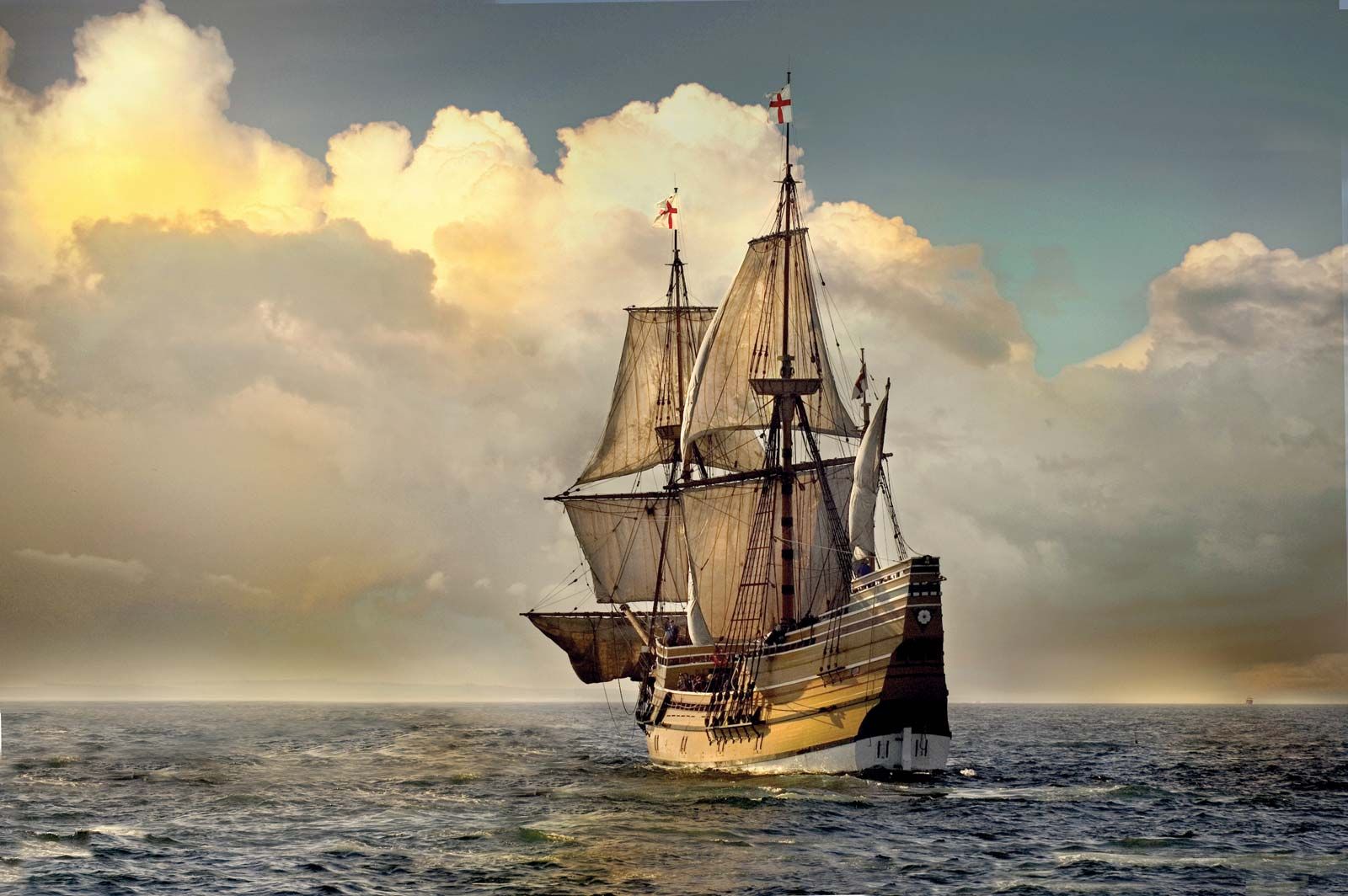
Mayflower
- Type
- Galleon
- Period
- 17th Century
- Nation
- Great Britain
Overview: The Mayflower was an English merchant ship famed for carrying 102 Pilgrim colonists from England to Plymouth, Massachusetts in 1620, helping found Plymouth Colony. No plans, paintings, or detailed contemporary descriptions of her survive, so all reconstructions (including the modern replica) are based on scholarly estimates of typical merchant ships of the period. Specifications: Historians describe her as a wine-ship (a vessel that ordinarily carried casks of wine or other cargo) of roughly 180 tons burden. Estimates place her overall length around 100-110 feet (with a hull/deck length of about 80-90 feet), a beam of about 25 feet, and around four decks; she would have carried a small battery of cannon for self-defense typical of armed English merchantmen of the era. Service History: Mayflower departed Plymouth, England on September 16, 1620 bound for Virginia, but after a difficult Atlantic crossing made landfall far to the north at what is now Provincetown, Massachusetts, prompting the Pilgrims to settle at Plymouth instead. She returned to England in 1621, and her ultimate fate is uncertain - most accounts suggest she was broken up for her timber by around 1624, with one persistent (unconfirmed) tradition holding that her wood was reused in a barn in Jordans, England. Notable Facts: Because no original plans exist, the well-known 1957 replica, Mayflower II, was designed by naval historian William Avery Baker using period ship-construction knowledge rather than direct documentation. Built in Brixham, Devon and sailed across the Atlantic in 1957 under Captain Alan Villiers, Mayflower II was presented to the United States as a gesture of post-war goodwill and remains on exhibit - and periodically sails - at Plymouth, Massachusetts; she was added to the U.S. National Register of Historic Places in 2020 following a major restoration.
Kits of this ship
Build Logs
+ Link a build logNo build logs linked yet.
Resources
+ Submit a resource- Wikipedia: Mayflower (1620 ship)Website
Overview of the original Mayflower's known history, estimated dimensions, tonnage, and uncertain fate after 1624.
- Wikipedia: Mayflower II (1957 replica)Website
Detailed specifications, construction history, and museum-ship status of the full-scale replica now at Plymouth, MA - useful for scaling a model.
- Britannica: Mayflower Ship HistoryArticle
Concise encyclopedia summary of the ship's construction, voyage, and unresolved fate, with estimated tonnage and length.
- The Conversation: Mayflower 400 - The Science of SailingArticle
Academic discussion of the ship's likely hull form, armament, and rigging based on period merchant-ship design, helpful for modelers reconstructing plausible details.