 Ship Modelers Database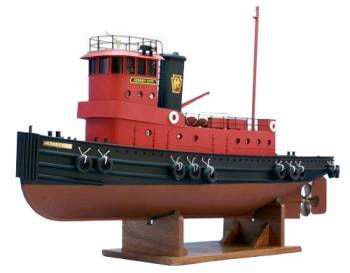
Jersey City (tugboat)
Unknown
Jersey City is a U.S. East Coast railroad harbor tug that served as the prototype for a popular Dumas Products radio-control model kit. The real vessel was a working car-float/railroad tug operating in the New York Harbor area, of the type used by railroads to push and tow car floats carrying freight cars across the Hudson and Upper New York Bay between New Jersey rail yards and New York City terminals.
Kits of this ship
+ Add a kitNo kits listed for this ship yet.
Plans
No plan sets listed for this ship yet. Know of museum, archive or publisher drawings? Add them so the next builder can find them.
Links go to the publisher's or museum's own page. Ship Modelers Database lists plan sets; it doesn't host or display the drawings.
Build logs
+ Link a build logNo build logs linked yet.
Resources
+ Submit a resourceNo resources submitted yet.
History
Service history
Described by the kit manufacturer as a railroad tug dating to the 1960s that was reportedly still working the eastern seaboard decades later, Jersey City represents the class of diesel-era harbor tugs that kept the region's extensive car-float network running after steam tugs were phased out. Tugs of this type, operated by railroads such as the New York Central, Pennsylvania, Lehigh Valley and Erie-Lackawanna, were the workhorses of New York Harbor's freight transfer system until containerization and the decline of car-float service in the later 20th century.
Specifications
As rendered in the Dumas model kit, the prototype scales out to roughly a 36-inch-long, 9-inch-beam hull at 1/32 scale, implying a real vessel on the order of 96 feet in length — consistent with typical mid-20th-century harbor/railroad tug dimensions. The kit features a vacuum-formed hull, die-cut superstructure parts, and single-screw running gear, reflecting a conventional single-propeller harbor tug layout.
Notable facts
Unlike many named historic tugs (e.g., the preserved Pegasus/Standard Oil No. 16 or the scrapped New York Central Tugboat 16), Jersey City does not appear to have individual listing in naval history or preservation databases — most available documentation comes from hobby manufacturer product descriptions rather than maritime archives, so details of her builder, final disposition, and exact service dates remain unconfirmed. Modelers should treat the Dumas kit's box description as the primary available account of her career.