 Ship Modelers Database
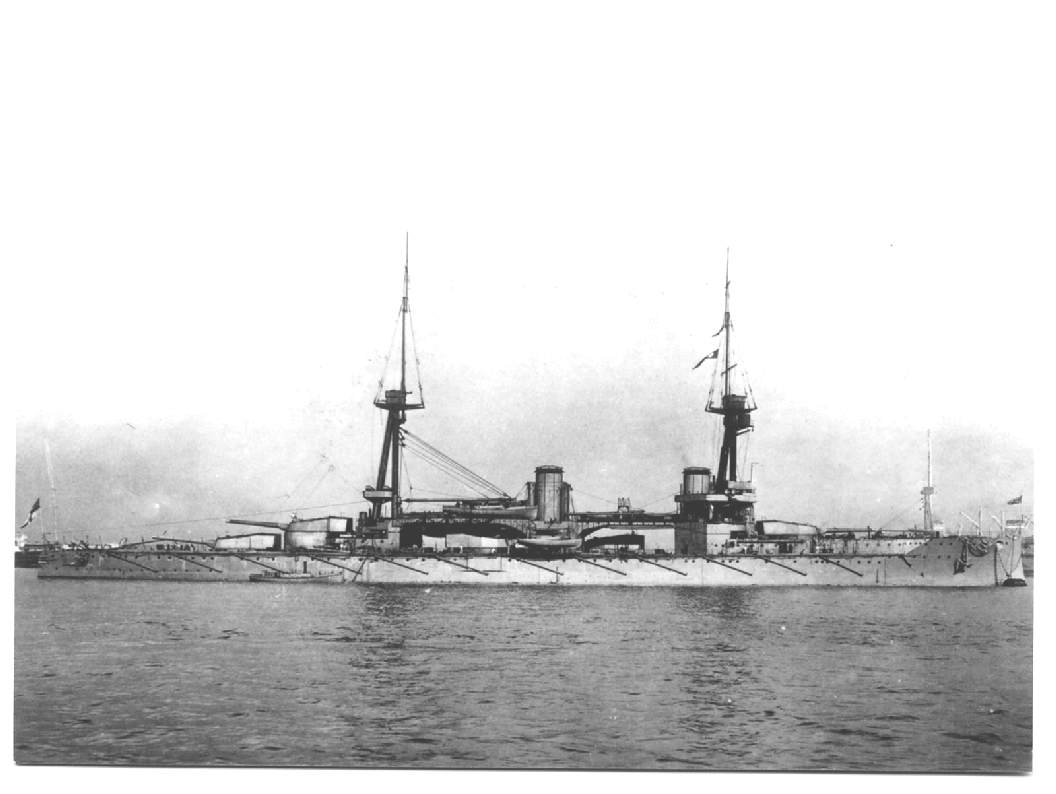
Image: Public domain · commons.wikimedia.org
HMS Neptune (1909)
Scrapped
HMS Neptune was a dreadnought battleship built for the Royal Navy at HM Dockyard, Portsmouth, and was the sole ship of her class before her intended sisters were redesigned with thicker armour and reclassified as the Colossus class. She is notable to modelers as the first British battleship built with superfiring turrets and the first to trial a gunnery director system.
Kits of this ship
+ Add a kit| HMS Neptune Battleship, 1911 | Combrig Models | 1:700 | Resin | Discontinued |
Plans
No plan sets listed for this ship yet. Know of museum, archive or publisher drawings? Add them so the next builder can find them.
Links go to the publisher's or museum's own page. Ship Modelers Database lists plan sets; it doesn't host or display the drawings.
Build logs
+ Link a build logNo build logs linked yet.
Resources
+ Submit a resourceHistory & specifications
- Wikipedia: HMS Neptune (1909)Website
Comprehensive overview of design, armament, armour, and service history, useful for accurate specifications when building a model.
- Wikipedia: List of Dreadnought Battleships of the Royal NavyWebsite
Summarizes Neptune's place among RN dreadnoughts with key service and fate details for cross-reference.
History
Specifications
Neptune had an overall length of 546 feet (166.4 m), a beam of 85 feet (25.9 m), and a deep draught of 28 feet 6 inches (8.7 m), displacing 19,680 long tons at normal load. Her main armament was ten 12-inch guns in five twin turrets - three on the centreline (A, X, Y) and two wing turrets (P, Q) staggered "en echelon" so that, in theory, all five turrets could fire on the broadside. Secondary armament comprised sixteen 4-inch guns in unshielded single mounts, plus three 18-inch torpedo tubes, and her belt armor ranged from 8 to 10 inches.
Design notes
Unlike earlier dreadnoughts, Neptune's superfiring aft turrets and echeloned wing turrets were meant to maximize broadside firepower while saving hull length, though in practice blast damage to the superstructure and boats limited the wing turrets' usefulness, and the upper superfiring turret could damage the lower turret's sighting hoods when traversing near the stern. Her ship's boats were carried on girders over the wing turrets, a vulnerable arrangement if damaged in action.
Service history
Commissioned in January 1911, Neptune served as flagship of the Home Fleet before being replaced by Iron Duke in 1914 and assigned to the 1st Battle Squadron, later becoming part of the Grand Fleet at the outbreak of the First World War. She fought at the Battle of Jutland in May 1916, firing 48 main-gun shells and being credited with hits on the German battlecruiser Lützow, and was accidentally rammed by the neutral merchant ship SS Needvaal in April 1916 without serious damage. Deemed obsolete after the war, she was placed in reserve and sold for scrap in 1922.
Notable facts
Neptune's secondary 4-inch guns were the first on a British dreadnought mounted unshielded in the superstructure rather than on turret roofs, addressing earlier ammunition-handling problems. She also served as a test platform for Vice-Admiral Sir Percy Scott's prototype gunnery director, a system subsequently adopted across the Royal Navy's dreadnought fleet.