 Ship Modelers Database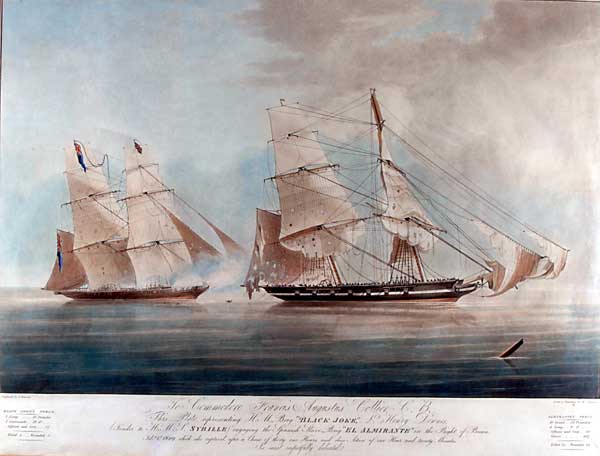
HMS Black Joke (1827)
- Type
- Brig
- Period
- 19th Century
- Nation
- Great Britain
Overview: HMS Black Joke was a fast Baltimore-built brig famous for her second career as a Royal Navy anti-slavery cruiser with the West Africa (Preventive) Squadron. She began life as the slaver Henriquetta before being captured and repurposed to hunt down the very trade she once served. Specifications: She was a Baltimore clipper of approximately 260 tons burthen, 90 ft 10 in long with a 26 ft 7 in beam, rigged as a brig, with a complement of 34 sailors and 5 marines, armed with one 18-pounder pivot-mounted cannon. At the time of her original capture she was smaller and less armed; Commodore Francis Collier of Sybille noted that at the time of her capture Henriquetta was 257 tons, mounted three guns and had a crew of 38 men. Service History: HMS Black Joke was a cutter, probably built in Baltimore in 1824, originally launched as the Brazilian slave ship Henriquetta; the Royal Navy captured her in September 1827 and purchased her into the service, renaming her Black Joke after an English song of the same name and assigning her to the West Africa Squadron. Her role was to chase down slave ships, and over her five-year career, she freed thousands of slaves. In a celebrated 1829 action, Black Joke chased the Spanish slaver El Almirante for 31 hours and resorted to sweeps to close within gunshot; though outgunned and half El Almirante's size, good ship-handling and discipline gave Lieutenant Downes the advantage, and in 80 minutes he defeated and captured the slaver, freeing 466 slaves aboard. She also fought a notable engagement against the larger, more heavily armed Spanish slaver Marinerito in 1831, and between November 1830 and March 1832, Black Joke and Fair Rosamond accounted for 11 out of the squadron's take of 13 slavers. Notable Facts: Before her Royal Navy service, as Henriquetta she was a Baltimore clipper built for speed, purchased by Brazilian owners in 1825 who worked her for a slave dealer at Bahia, making £80,000 by running 3,040 slaves across to Brazil in six voyages over three years. Her ultimate fate was ignoble: the Navy deliberately burnt her in May 1832 because her timbers had rotted to the point that she was no longer fit for active service. Her story has since inspired popular histories, including A.E. Rooks's book on the ship's anti-slave-trade battles; the National Maritime Museum also holds relics such as a wine cooler made from El Almirante's timbers and a snuff box made from Black Joke's timbers.
Kits of this ship
No kits linked yet.
Build Logs
+ Link a build logNo build logs linked yet.
Resources
+ Submit a resource- Wikipedia: HMS Black Joke (1827)Website
Detailed overview of the ship's origins as the slaver Henriquetta, capture, Royal Navy service, and fate; primary reference for specs and service history.
- Wikimedia Commons: HMS Black Joke (1827) painting by Nicholas CondyMuseum
Public-domain period painting showing HMS Black Joke firing on the Spanish slaver El Almirante, useful as a visual reference for hull lines and rig.
- RMG: 'Black Joke' engaging the Spanish slave brig 'Almirante'Museum
Royal Museums Greenwich catalog entry on a Huggins print of the El Almirante action, with details on the engagement and surviving relics made from the ships' timbers.
- Royal Naval Museum: HMS Black Joke capturing El AlmiranteMuseum
Museum exhibition page summarizing Black Joke's origin, capture, and record as one of the most successful anti-slavery cruisers in the squadron.