 Ship Modelers Database
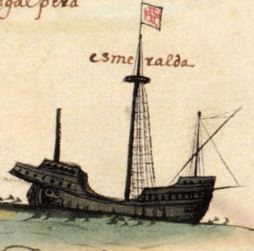
Image: Public domain (anonymous work, c. 1568) · en.wikipedia.org
Esmeralda (carrack)
Sunk
Esmeralda was a Portuguese carrack (nau) that formed part of Vasco da Gama's fourth India Armada of 1502, commanded by da Gama's maternal uncle Vicente Sodré. She is historically significant as the earliest shipwreck yet identified from Europe's maritime Age of Discovery, her wreck-site having been located off Oman and scientifically confirmed through archaeological excavation.
Kits of this ship
+ Add a kitNo kits listed for this ship yet.
Plans
No plan sets listed for this ship yet. Know of museum, archive or publisher drawings? Add them so the next builder can find them.
Links go to the publisher's or museum's own page. Ship Modelers Database lists plan sets; it doesn't host or display the drawings.
Build logs
+ Link a build logNo build logs linked yet.
Resources
+ Submit a resourceHistory & specifications
- International Journal of Nautical Archaeology: A Portuguese East Indiaman from the 1502-1503 Fleet of Vasco da Gama off Al Hallaniyah Island, OmanArticle
Peer-reviewed interim excavation report detailing the wreck-site identification, recovered artefacts, and the archaeological case for the wreck being the Esmeralda.
- Wikipedia: CarrackWebsite
Background on the carrack (nau) ship type, its design evolution, and use by Portugal and Spain for ocean trade, useful context for modeling the hull form and rig.
- Wikipedia: Esmeralda (carrack)Website
Overview article summarizing the ship's loss in 1503, its 1998 discovery and 2013-15 excavation, and recovered artifacts including the earliest known mariner's astrolabe.
History
Service history
Esmeralda was one of five ships in a squadron (three naus and two caravels) left behind by da Gama to patrol the Indian Ocean and disrupt trade between India and the Red Sea, operating alongside her sister ship São Pedro under Vicente and Brás Sodré. In April-May 1503, after a raiding cruise in the Gulf of Aden, the squadron put in to Al Hallaniyah Island (Khuriya Muriya Islands) off Oman to shelter and careen; a sudden storm wrecked both naus, with Esmeralda lost in deeper water along with Vicente Sodré and her entire crew, while São Pedro's crew largely escaped ashore.
Discovery and excavation
The wreck-site was first located by a two-man survey team in 1998 using historical accounts and metal detectors, then excavated by David Mearns and Blue Water Recoveries in partnership with Oman's Ministry of Heritage and Culture between 2013 and 2015. Diagnostic finds—including a rare Portuguese trade coin, stone cannonballs marked "V S" (likely for Vicente Sodré), a ship's bell dated 1498, and the earliest known mariner's astrolabe (c. 1496-1501)—support the identification of the site as Esmeralda rather than São Pedro, though absolute certainty remains elusive since no ship's structure or name plate survived.
Notable facts
No contemporary builder's plans or precise dimensions for Esmeralda survive; like other large naus of the fleet (the flagship São Jerónimo and Lionarda), she is presumed to have displaced roughly 250 tons or more, suitable for the long spice-cargo run back to Lisbon. A period illustration of her sinking appears in the Livro das Armadas da Índia (c. 1568), a Portuguese illuminated manuscript held by the Academia das Ciências de Lisboa, which remains the only known visual depiction of the ship. For modelers, she represents a typical early 16th-century Portuguese India-run carrack rather than a uniquely documented design, so reconstructions necessarily draw on generic nau conventions of the period.