 Ship Modelers Database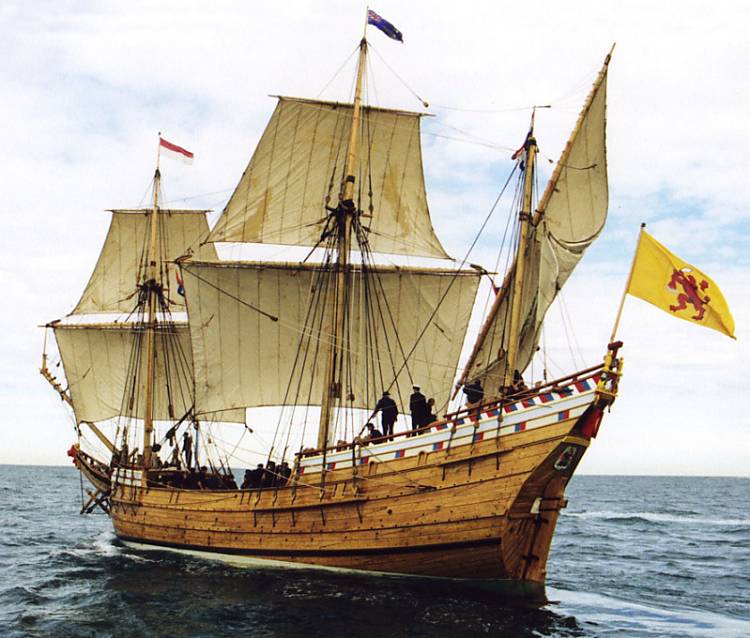
Duyfken
- Type
- Pinnace
- Period
- 17th Century
- Nation
- Netherlands
Overview: Duyfken ("Little Dove") was a small, fast Dutch pinnace built in the Dutch Republic and put into VOC service in the early 17th century. She is historically significant as the ship that made the first recorded and authenticated European landfall on the Australian continent in 1606, under Captain Willem Janszoon. Specifications: The original vessel is estimated at roughly 19.6 m (64 ft) length and 5.45 m (17.9 ft) beam, with a depth of hold around 1.85 m and a tonnage of about 25-30 lasten. She carried around 8 cannons and was rigged as a full-rigged pinnace on three masts, and was described as a fast, lightly armed vessel probably suited to shallow water, small valuable cargoes, message-running, or privateering rather than heavy cargo or firepower. Service History: Duyfken served the VOC on trading, scouting, and dispatch duties around the East Indies, with Willem Janszoon serving as her captain from 1603. In 1605-1606 she sailed from Bantam (Java) on a voyage of discovery that reached the Gulf of Carpentaria coastline of Australia, over a century and a half before Cook's later exploration of the east coast. By July 1608 the ship had been damaged beyond repair and was condemned at Ternate, ending her career in obscurity in the Indies. Notable Facts: Because no original builder's plans or half-models survived (shipyards of the era did not use written plans), the design used for the 1999 Australian-built replica was reconstructed largely from a single contemporary drawing found in the logbook of the VOC flagship Gelderlandt (1601) plus general knowledge of period Dutch shipbuilding. The full-size, sailing replica was built by the Duyfken 1606 Replica Foundation jointly with the Maritime Museum of Western Australia, launched 24 January 1999 in Fremantle, and constructed plank-first in the traditional manner using oak timber; it has since toured extensively, including retracing the 1606 voyage, and is now associated with the Australian National Maritime Museum. For modelers, the scarcity of primary source plans means most kits (such as those from Kolderstok and Modelers Shipyard) and scratch-built models rely on the replica's reconstructed lines rather than an original draught.
Kits of this ship
No kits linked yet.
Build Logs
+ Link a build logNo build logs linked yet.
Resources
+ Submit a resource- Wikipedia: DuyfkenArticle
Overview of the original 1601 VOC pinnace, her voyage to Australia in 1606, loss in 1608, and the 1999 replica project; includes basic dimensions and armament useful for modeling.
- Wikimedia Commons: Duyfken Replica Under Sail.jpgMuseum
CC BY-SA 3.0 licensed photo of the full-size sailing replica under sail, useful as a visual reference for rigging and hull form.
- City of Fremantle Local History Centre: The DuyfkenWebsite
Local history record describing the 1994-1999 Fremantle build of the Duyfken replica, including keel-laying and launch dates and construction cost.
- Australian National Maritime Museum: Duyfken Fleet VesselMuseum
Museum page on the 1999 replica's construction, launch, and current operating status as a fleet/education vessel.
- City of Fremantle Local History Centre: The DuyfkenMuseum
Local archive record with construction timeline (keel laying, launch date, cost) for the Fremantle-built replica, useful for build context.
- ABC Science: The Duyfken - An Experiment in Marine ArchaeologyArticle
First-person account by the replica's research coordinator describing plank-first construction methods and the design reconstruction process, valuable for modelers interested in build accuracy.