 Ship Modelers Database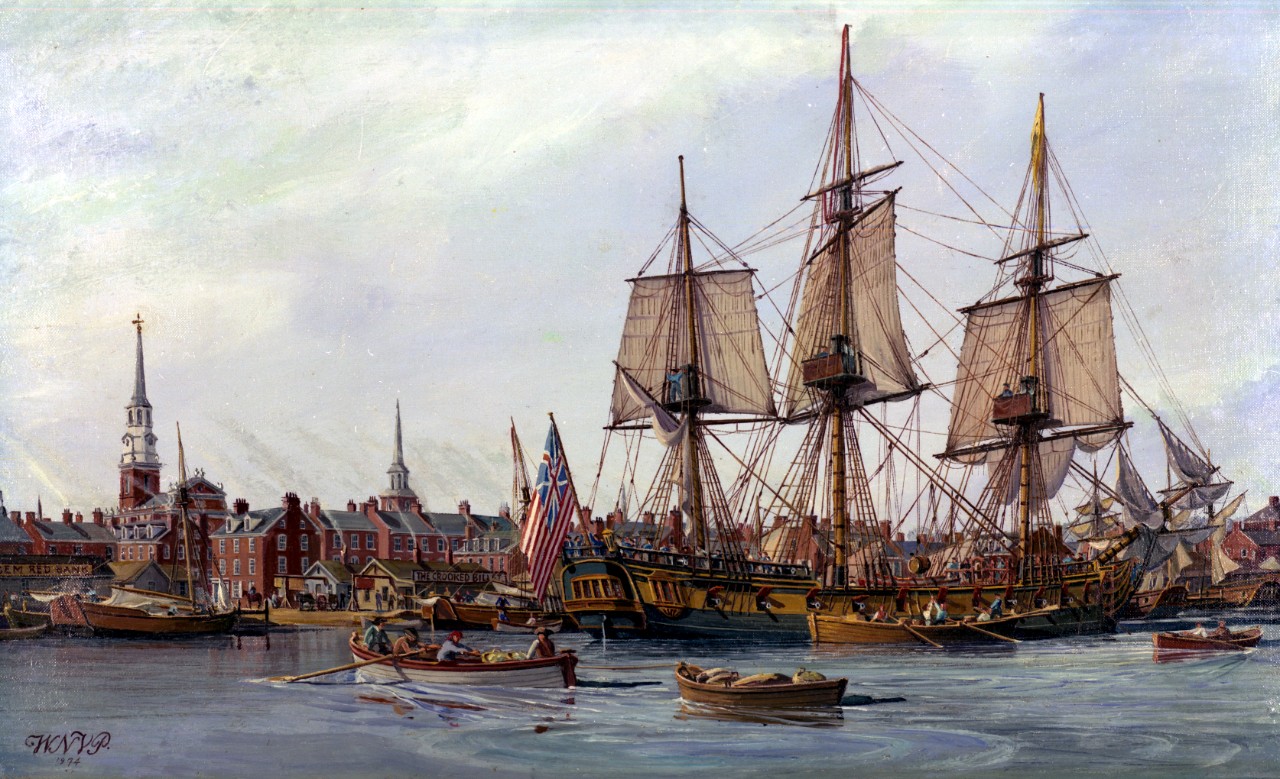
Alfred
- Type
- Frigate
- Period
- 18th Century
- Nation
- United States
Overview: Alfred was the first flagship of the Continental Navy and is considered by many historians to be the first true warship of what would become the United States Navy. Originally built as the Philadelphia merchantman Black Prince in 1774, she was purchased and converted into a man-of-war in late 1775, becoming the flagship of Commodore Esek Hopkins' inaugural American naval squadron. Specifications: As rebuilt for naval service, Alfred measured 440 tons burthen, with a length around 140 feet, a beam of about 32 feet, and a draft of roughly 15 feet, carrying a complement of 220 officers and men. Her armament comprised 20 x 9-pounder guns on the gun deck and 10 x 6-pounder guns on the quarterdeck and forecastle, though later returns show variations in her broadside as guns were adjusted. Wikipedia and the Naval History and Heritage Command both class her as a 24 (or 30) gun frigate, and she was rigged as a three-masted ship. Service History: Alfred was commissioned at Philadelphia on 3 December 1775, where Lieutenant John Paul Jones famously raised the Grand Union Flag for the first time aboard her. Under Captain Dudley Saltonstall and later John Paul Jones and Elisha Hinman, she took part in the first American amphibious landing operation at New Providence, Bahamas, to capture the forts for much needed ordnance and gunpowder, and in the inconclusive action against HMS Glasgow off Block Island on 6 April 1776. On 9 March 1778, while cruising with other Continental vessels, she encountered British warships Ariadne and Ceres near Barbados; as the American ships began to flee, Alfred fell behind, and shortly after noon the British caught up with her, forcing her surrender after a half-hour battle. Notable Facts: After capture, the Royal Navy took her into service as HMS Alfred, a 20-gun sloop, before selling her in 1782; she then resumed life as a merchantman, sailing between London and the British colony of Jamaica, with Lloyd's Register still recording her active in trade as late as 1789. For scale modelers, her dual identity as both a converted merchant ship and a purpose-modified warship (with strengthened hull, added gunports, and reworked bulwarks) makes her an interesting subject showing the transition from civilian to naval configuration. She should not be confused with the later, unrelated 74-gun Royal Navy ship of the line HMS Alfred (1778), an Alfred-class third-rate with entirely different dimensions and armament.
Kits of this ship
| CNS Alfred | BlueJacket Shipcrafters | 1:96 (1/8 in=1 ft) | Available |
Build Logs
+ Link a build log- HMS Alfred 1778 1/48 scale. scratch buildgaryshipwright (likely) · Ships of Scale
Scratch build log of the 74-gun HMS Alfred (1778) at 1/48 scale with in-progress frame and hull photos; builder identity inferred from a related SOS post but not fully confirmed.
Resources
+ Submit a resource- USS Alfred WikipediaWikipedia Entry
- The First Continental Flagship, 1775-1778 (John J. McCusker, Smithsonian Institution Press, 1973)Book
A dedicated Smithsonian monograph tracing Alfred's full service history including her three wartime cruises, an essential primary-source-based reference for accurate historical context.
- Alfred - Naval History and Heritage Command Ship HistoryArticle
Official U.S. Navy history page with period paintings (including the Van Powell depiction of Jones raising the Grand Union flag) useful for flag, rigging, and appearance reference.
- Models on Display - National Museum of the U.S. NavyMuseum
Museum catalog listing confirms the exact location (Bldg. 76, Bay 2) of the Alfred display model for modelers planning research visits or photo requests.